
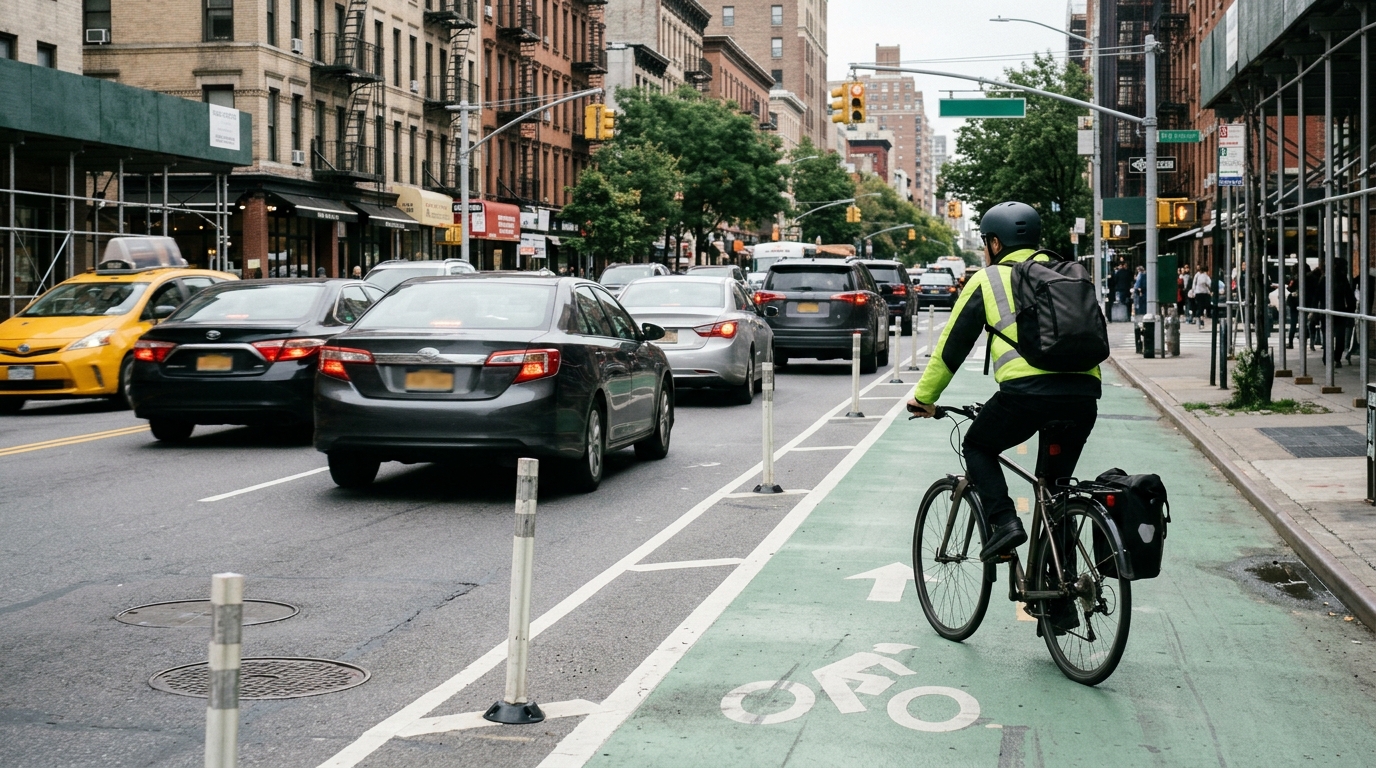
Bicyclists in New York generally have the same roadway rights and responsibilities as motor vehicle drivers. When a cyclist is injured because of a negligent driver, unsafe road conditions, or another responsible party, they may be entitled to compensation. Determining liability requires examining traffic laws, accident evidence, injury documentation, and the conduct of everyone involved.
Understanding bicycle accident rights and roadway liability can help injured cyclists recognize potential negligence, preserve evidence, and navigate New York’s insurance and personal injury claim requirements.
Quick Answer: What Rights Do Bicyclists Have After an Accident in New York?
New York law generally protects cyclists’ right to use public roadways while requiring them to obey applicable traffic rules.
Important legal considerations include:
- Roadway Rights: Cyclists generally have the rights and duties applicable to motor vehicle operators.
- Driver Responsibility: Motorists must exercise reasonable care around cyclists, including when turning, passing, or entering intersections.
- Bicycle Lane Rules: Cyclists must follow applicable roadway-positioning requirements, subject to important statutory exceptions.
- Comparative Negligence: Cyclists may recover damages even when they share responsibility for an accident.
- Insurance Benefits: A cyclist injured by a covered motor vehicle may qualify for New York no-fault benefits.
- Compensation: Eligible claims may involve medical expenses, lost income, bicycle damage, and qualifying non-economic losses.
Liability depends on the facts of the collision, and an injured cyclist’s rights should be evaluated under the applicable legal and insurance rules.
What Rights Do Bicyclists Have on New York Roads?
New York recognizes bicycles as legitimate roadway users. Cyclists generally may use public roads and are entitled to protections under state traffic laws.
However, bicycle operation is also governed by specific regulations addressing lane positioning, safety equipment, and interactions with other road users.
Do Cyclists Have the Same Rights as Drivers?
Under New York Vehicle and Traffic Law Section 1231, cyclists generally possess the same rights and must follow the same duties as motor vehicle drivers, except where bicycle-specific provisions apply or a rule cannot reasonably apply to bicycles.
This means cyclists generally must obey traffic signals, stop signs, applicable right-of-way rules, and other traffic regulations.
NYSenate.gov+1
Drivers cannot disregard a cyclist’s lawful presence merely because a bicycle is smaller or travels more slowly than a passenger vehicle.
Where Are Cyclists Allowed to Ride?
New York Vehicle and Traffic Law Section 1234 generally addresses bicycle positioning on roadways, shoulders, and bicycle lanes outside New York City, which has additional local traffic rules.
Cyclists traveling below the normal speed of traffic generally must use a suitable bicycle lane, or ride near the right-hand curb or edge of the roadway, subject to statutory exceptions.
Exceptions can include circumstances involving unsafe conditions, obstacles, certain passing maneuvers, and preparing for authorized turns.
The New York State Department of Transportation explains that cyclists are not always required to remain at the extreme right when roadway conditions make that position unsafe.
dot.ny.gov+1
Can Cyclists Use an Entire Traffic Lane?
In certain circumstances, yes.
A cyclist may need additional road space when avoiding hazards, positioning for a lawful turn, or navigating a lane too narrow to share safely with a motor vehicle.
Whether the cyclist’s position was lawful depends on the applicable state and local requirements and the specific conditions.
A driver’s preference that a bicycle remain at the road’s edge does not automatically establish that the cyclist was violating traffic law.
Who Is Responsible for a Bicycle Accident in New York?
Responsibility depends on negligence, meaning that a party failed to exercise legally required care and that failure caused compensable harm.
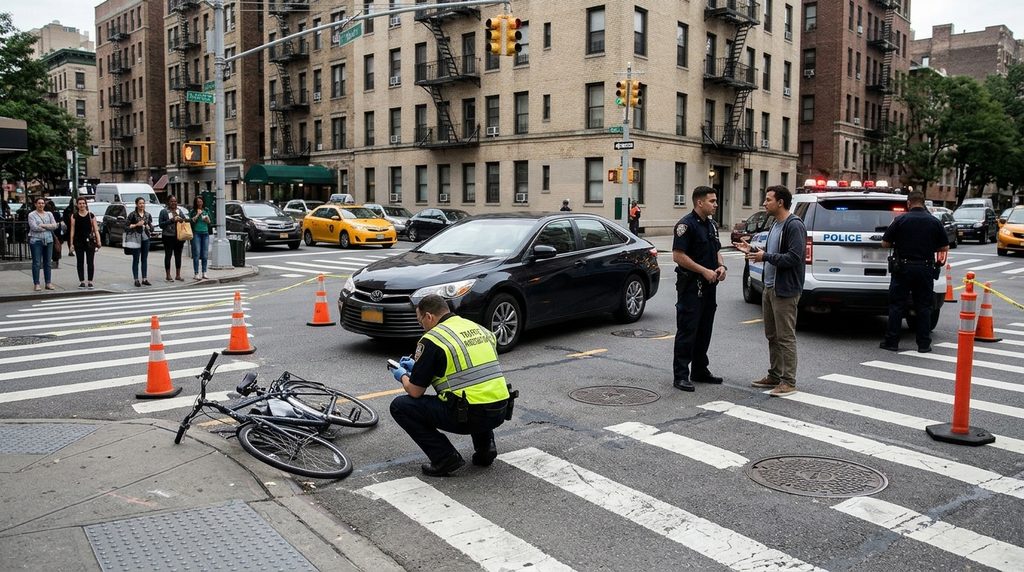
A bicycle collision may involve driver negligence, cyclist negligence, or the conduct of multiple parties.
Common Examples of Driver Negligence
Motorists may contribute to bicycle accidents through several types of unsafe conduct:
- Failing to yield at intersections.
- Making unsafe right or left turns.
- Changing lanes without checking for cyclists.
- Driving while distracted.
- Passing too closely.
- Opening vehicle doors into approaching bicycle traffic.
- Speeding or disregarding traffic signals.
- Entering bicycle lanes unlawfully.
Each situation requires an assessment of the available evidence.
For example, a collision involving a right-turning vehicle and a cyclist traveling straight may raise questions about signaling, the position of both road users, and whether the driver checked the intended turning path.
Can Vehicle Owners Be Liable?
In some circumstances, a vehicle owner may face liability even when another person was driving.
New York Vehicle and Traffic Law Section 388 can impose responsibility on qualifying vehicle owners for negligent operation by people using the vehicle with the owner’s permission.
The rule has limitations and exceptions, so the vehicle’s ownership and use must be evaluated individually.
Can Multiple Parties Share Responsibility?
Yes. An accident may result from several contributing acts.
For example, a driver might make an unsafe turn while a cyclist simultaneously disregards an applicable traffic signal.
The relative responsibility of each party depends on the evidence and the applicable negligence standards.
Understanding New York road accident liability can help explain how multiple causes, driver conduct, and the allocation of responsibility may affect an injury claim.
How Does Comparative Negligence Affect Bicycle Accident Compensation?
New York follows a pure comparative negligence system.
Under CPLR Section 1411, a claimant’s contribution to the accident generally reduces recoverable damages proportionally rather than automatically preventing recovery.
Example of Comparative Fault
Suppose a cyclist suffers $100,000 in legally recoverable damages after a collision. The evidence establishes that the driver was 75% responsible and the cyclist was 25% responsible.
Illustrative allocation of bicycle accident damages
Total damages
$100,000
Cyclist’s fault
25%
Adjusted damages
$75,000
Hypothetical example only. Insurance limits and other legal considerations can affect actual recovery.
The damages would generally be reduced by $25,000, leaving $75,000 before considering other applicable restrictions.
Does Violating a Bicycle Law Eliminate a Claim?
Not necessarily.
A violation may be relevant to the negligence analysis, but its significance depends on whether the conduct contributed to the collision and the applicable legal rules.
For example, failing to obey a stop sign may affect fault when that failure contributes to an intersection accident.
However, an unrelated equipment violation does not automatically establish responsibility for every collision.
The underlying conduct and its causal relationship to the injuries must be examined.
What Happens When a Driver Hits a Cyclist in a Bicycle Lane?
Bicycle lanes are intended to provide designated space for bicycle travel, but they do not eliminate the risk of collisions.
Drivers may turn across bicycle lanes, fail to look for approaching cyclists, or create hazards through unlawful stopping or parking.
Right-Turn and Left-Turn Collisions
Turning accidents can occur when a motorist crosses a cyclist’s path without adequately checking for bicycle traffic.
A cyclist traveling straight may have priority over a turning driver, depending on the roadway markings, traffic signals, and applicable rules.
Camera footage, witness statements, and accident reconstruction may help determine whether the driver failed to yield.
Bicycle Lane Obstructions
Vehicles, construction materials, debris, or other obstacles may force cyclists to change their roadway position.
An obstruction does not automatically establish legal liability against its owner or the entity responsible for the area.
Investigators must determine whether the condition was dangerous, whether a party had a legal duty to address it, and whether the condition contributed to the crash.
Dooring Accidents
A dooring accident occurs when someone opens a vehicle door into the path of an approaching cyclist.
Under New York Vehicle and Traffic Law Section 1214, a person generally may not open a vehicle door on the side available to moving traffic unless doing so is reasonably safe and does not interfere with other traffic.
A violation may provide relevant evidence of negligence when a cyclist is injured by an opening vehicle door.
Can Dangerous Road Conditions Cause a Bicycle Accident Claim?
Not every bicycle accident involves a negligent driver.
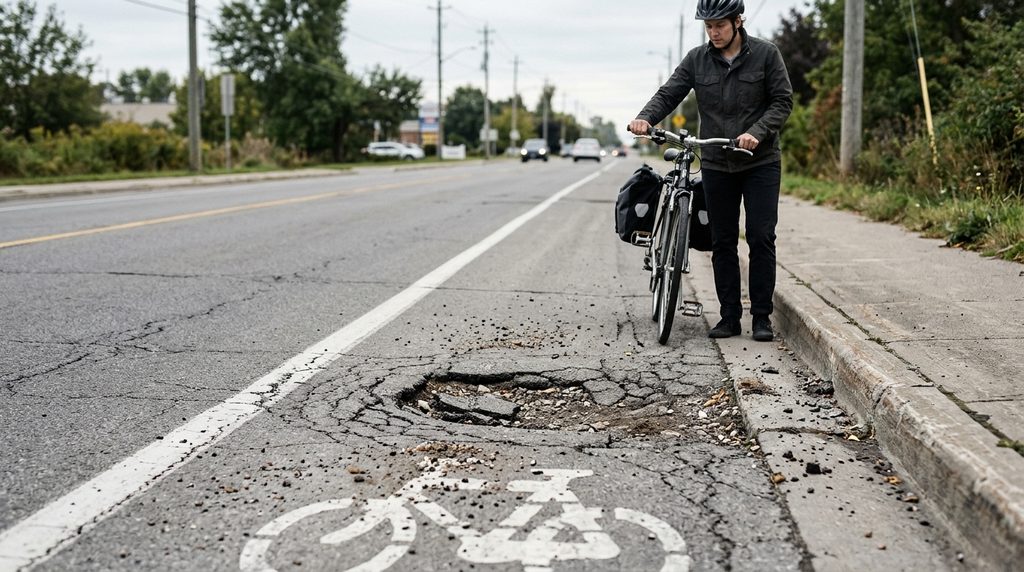
Some crashes result from potholes, damaged pavement, unsafe construction conditions, or other roadway hazards.
These incidents may involve claims against contractors, property owners, or governmental entities, depending on who controlled the location and what legal duties applied.
Common Roadway Hazards
Potentially dangerous conditions include:
| Roadway Condition | Potential Risk to Cyclists |
| Deep Potholes | Sudden loss of balance or wheel damage |
| Uneven Pavement | Reduced stability and control |
| Loose Gravel or Debris | Loss of traction |
| Unsafe Construction Areas | Unexpected lane changes or obstacles |
| Drainage Grates | Wheel obstruction or steering instability |
| Poorly Maintained Bicycle Lanes | Hazardous riding surfaces |
The existence of a hazard alone does not prove negligence.
A claimant generally must establish the elements of the relevant cause of action, including the responsible party’s duty, legally sufficient notice where required, and causation.
Government Roadway Liability
Claims involving public roads can be particularly complex.
Some municipalities require proof of prior written notice of certain roadway defects, subject to limited exceptions.
Government-related claims may also involve special notice-of-claim procedures and shorter filing deadlines.
Identifying the correct responsible government entity is essential because ownership, maintenance responsibilities, and applicable statutes can vary.
How Does New York No-Fault Insurance Apply to Bicycle Accidents?
New York no-fault insurance may provide benefits when a cyclist is injured by a covered motor vehicle.
A person riding a conventional bicycle who is struck by a car is generally treated similarly to a pedestrian for purposes of qualifying no-fault benefits.
What Expenses May No-Fault Insurance Cover?
Basic New York Personal Injury Protection coverage generally provides up to $50,000 per eligible person for qualifying economic losses.
Potential benefits include medical expenses, a portion of lost wages within statutory limits, and certain necessary accident-related expenses.
The New York Department of Financial Services explains the general no-fault coverage framework, including protection for eligible people injured by insured vehicles.
Department of Financial Services
No-fault coverage is subject to policy provisions, eligibility requirements, deadlines, and statutory exclusions.
Which Insurer Handles a Cyclist’s No-Fault Claim?
When a qualifying cyclist is struck by a covered vehicle, the claim will generally involve the insurance company covering the vehicle involved in the collision.
More complicated situations may arise when multiple vehicles are involved, the driver is uninsured, or the vehicle cannot be identified.
The appropriate insurer and available benefits depend on the circumstances and applicable priority rules.
What If No Motor Vehicle Was Involved?
A bicycle accident involving only a roadway defect, another conventional bicycle, or a fall without a motor vehicle generally does not trigger ordinary automobile no-fault benefits.
Other insurance coverage or legal claims may be relevant.
This distinction matters because the availability of no-fault benefits is not determined simply by the severity of the cyclist’s injuries.
What Is the Filing Deadline?
Written notice of a New York no-fault claim is generally required within 30 calendar days after the accident, subject to applicable exceptions for justified late notice.
Other deadlines may apply to medical bills and proof of lost earnings.
A no-fault filing deadline is separate from the deadline for bringing a lawsuit.
What Evidence Helps Establish Liability After a Bicycle Accident?
Bicycle accident claims often depend on evidence showing where the cyclist was positioned, how the vehicles moved, and whether anyone violated applicable traffic rules.
Preserving this information can help address conflicting accounts of the collision.
Photographs and Video Evidence
Photographs can document roadway conditions, bicycle damage, vehicle impact areas, lane markings, and surrounding traffic-control devices.
Video recordings may provide additional evidence of the collision sequence.
Potential sources include traffic cameras, commercial surveillance systems, dashcams, and bicycle-mounted cameras.
Because recordings may be deleted or overwritten, early identification of available footage can be important.
Witness Statements and Police Reports
Independent witnesses may describe the driver’s behavior, the cyclist’s movements, and the traffic conditions before the impact.
Police reports can provide an initial record of the incident, but they do not necessarily establish final civil liability.
The reliability of witness observations and the consistency of supporting evidence remain important.
Bicycle Damage and Physical Evidence
The bicycle itself may contain information about impact direction and collision mechanics.
Damaged helmets, protective equipment, and other personal property may also be relevant.
When liability is disputed, preservation of the bicycle before repairs or disposal may help prevent the loss of physical evidence.
What Injuries Are Common in Bicycle Accidents?
Cyclists can suffer serious injuries even when a collision occurs at a relatively low speed.
Unlike occupants of enclosed vehicles, bicyclists are more directly exposed to the force of an impact and contact with the roadway.
Common Bicycle Accident Injuries
Potential injuries include:
- Concussions and traumatic brain injuries.
- Facial and dental injuries.
- Fractures involving wrists, arms, legs, and collarbones.
- Neck and spinal injuries.
- Road rash and soft-tissue injuries.
- Ligament and tendon damage.
- Internal injuries.
- Nerve damage and long-term mobility problems.
Some injuries may not be immediately apparent.
A medical evaluation can help identify conditions requiring treatment and create documentation of symptoms and clinical findings.
Why Medical Documentation Matters
Medical records help establish the connection between an accident and the injuries being claimed.
Insurance companies may evaluate emergency treatment records, diagnostic imaging, specialist reports, rehabilitation records, and the progression of symptoms.
When a cyclist has a pre-existing medical condition, medical evidence may also be necessary to distinguish prior symptoms from new harm or accident-related aggravation.
Long-Term Injuries and Permanent Limitations
Serious bicycle accidents may result in lasting disabilities, chronic pain, or reduced employment capacity.
Future damages may require medical opinions, treatment projections, and vocational assessments.
The strength of the medical evidence can significantly affect the evaluation of a personal injury claim.
What Compensation Can Injured Cyclists Recover in New York?
The compensation available after a bicycle accident depends on the type of claim, applicable insurance rules, liability, and documented losses.
Recoverable damages may include economic losses and qualifying non-economic harm.
Economic Damages
Economic damages represent measurable financial consequences of an accident.
| Damage Category | Examples of Supporting Evidence |
| Medical Expenses | Hospital bills, physician records, rehabilitation invoices |
| Lost Income | Employer statements and wage records |
| Future Medical Care | Treatment projections and specialist opinions |
| Reduced Earning Capacity | Employment history and vocational evaluations |
| Bicycle and Equipment Damage | Repair estimates and replacement documentation |
| Other Eligible Expenses | Receipts and records of accident-related costs |
Not every claimed expense will necessarily be recoverable.
The claimant must satisfy applicable requirements concerning causation, reasonableness, coverage, and damages.
Pain and Suffering
Non-economic damages may involve physical pain, emotional suffering, and reduced enjoyment of life.
In a qualifying motor vehicle accident governed by New York’s no-fault system, a cyclist generally must establish a statutory serious injury to recover non-economic damages.
The serious injury categories are defined in New York Insurance Law Section 5102(d).
The applicable requirements can differ when the accident does not involve a covered motor vehicle.
Future Financial Losses
Severe injuries can affect the cyclist’s ability to return to work or perform previous job responsibilities.
Assessing future losses may require evidence concerning earning history, anticipated treatment, permanent restrictions, and the likely duration of those limitations.
No single settlement formula applies to every bicycle accident claim.
What Should Cyclists Do Immediately After a Bicycle Accident?
The first priority after a collision is personal safety and appropriate medical assistance.
Once immediate risks have been addressed, cyclists can take steps to preserve information and document the accident.
Seek Medical Attention
Call emergency services when someone is seriously injured or the collision creates an immediate hazard.
A person experiencing potential head, neck, or spinal injuries should avoid unnecessary movement.
Even when symptoms initially appear minor, medical evaluation may identify injuries that require treatment.
Report the Accident
Notify law enforcement when necessary, particularly when the collision causes injuries or significant property damage.
When a motor vehicle is involved, New York’s applicable crash-reporting requirements should also be reviewed.
Cyclists should keep available police report information and records of communications with the involved parties.
Preserve Relevant Evidence
When safe and medically appropriate, photograph the accident location, bicycle, involved vehicles, and relevant roadway conditions.
Collect witness contact information and preserve damaged equipment.
Document the date, approximate time, location, and circumstances while the details remain fresh.
Organize Medical and Financial Records
Keep copies of treatment records, medical invoices, employment documents, and insurance correspondence.
This information may help substantiate accident-related losses.
Cyclists should also keep a clear record of ongoing medical restrictions and follow-up treatment.
How Long Do Cyclists Have to File a Bicycle Accident Lawsuit?
New York generally provides a three-year statute of limitations for ordinary negligence-based personal injury lawsuits under CPLR Section 214(5).
The period ordinarily begins on the date of the injury, although exceptions and different deadlines may apply.
The New York Courts statute of limitations timetable explains general filing periods for civil claims.
New York Courts
Claims Involving Government Entities
Government-related bicycle accident claims may require a notice of claim within 90 days and may involve shorter lawsuit filing periods.
The exact requirements depend on the governmental defendant and the legal basis of the claim.
Roadway defect claims may also involve special prior written notice rules.
These cases should be evaluated promptly because missing a required notice or filing deadline may jeopardize recovery.
Do Insurance Negotiations Extend the Deadline?
No. Negotiating with an insurance company does not automatically suspend the applicable statute of limitations.
A cyclist should not assume that an open claim preserves the right to file a lawsuit indefinitely.
Insurance claim deadlines and court filing deadlines must be considered separately.
When Should an Injured Cyclist Contact an Attorney?
Legal representation may be useful when a bicycle accident results in serious injuries, disputed liability, substantial financial losses, or uncertainty about available insurance coverage.

Complex claims can involve multiple defendants, technical accident reconstruction, permanent injuries, or potentially negligent roadway maintenance.
How an Attorney Can Help
A qualified bicycle accident attorney may assist with reviewing liability evidence, identifying insurance coverage, evaluating damages, and explaining applicable legal deadlines.
Depending on the circumstances, legal representation may also involve investigating the collision, obtaining relevant records, consulting experts, and negotiating with insurers.
When litigation becomes necessary, an attorney can assess the available claims and procedural requirements.
When Is a Claim Particularly Complicated?
Situations that may justify additional legal evaluation include:
- A driver disputes responsibility for the collision.
- The cyclist suffers permanent injuries.
- Several vehicles contributed to the crash.
- A commercial vehicle was involved.
- Dangerous road conditions may have caused the accident.
- The responsible driver has insufficient insurance.
- A government entity may be responsible.
An experienced personal injury attorney can evaluate the facts and explain the legal options available under New York law.
No attorney can guarantee a particular settlement or litigation outcome.
Frequently Asked Questions
1. Do bicyclists have the same rights as drivers in New York?
Generally, yes. Under Vehicle and Traffic Law Section 1231, cyclists have the rights and duties applicable to motor vehicle drivers, subject to bicycle-specific rules and provisions that cannot reasonably apply to bicycles. Cyclists must follow traffic signals and relevant right-of-way requirements, while drivers must respect cyclists’ lawful use of the roadway.
2. Can a cyclist recover compensation if partly responsible for an accident?
Yes. New York’s pure comparative negligence system generally allows injured cyclists to recover damages even when they share responsibility. Their compensation may be reduced according to the percentage of fault assigned to them. The outcome depends on the available evidence and applicable legal standards.
3. Does New York no-fault insurance cover bicycle accidents?
A cyclist injured by a covered motor vehicle may qualify for no-fault benefits, including certain medical expenses and lost earnings. However, bicycle-only accidents generally do not trigger automobile no-fault coverage. Eligibility depends on the circumstances, applicable policies, and statutory requirements.
4. Can a cyclist sue for injuries caused by a pothole?
Potentially. A cyclist injured because of a dangerous roadway condition may have a claim against a responsible party if the necessary elements of liability can be established. Government-related cases may involve prior written notice requirements, special defenses, and shorter deadlines. The existence of a pothole alone does not establish negligence.
5. How much is a bicycle accident claim worth in New York?
There is no fixed settlement value. Compensation depends on the severity of injuries, liability evidence, medical expenses, income losses, future treatment requirements, comparative negligence, and insurance coverage. Claims involving permanent disabilities may require additional expert evaluation to assess long-term financial and non-economic losses.
Conclusion
Bicycle accident rights and roadway liability in New York depend on the relationship between cyclists’ legal protections, traffic regulations, and the circumstances surrounding an accident.
Cyclists generally have the same roadway rights and responsibilities as motor vehicle drivers, while motorists must exercise appropriate care when sharing the road. When negligence contributes to a collision, injured cyclists may pursue compensation subject to applicable insurance requirements and legal standards.
Preserving evidence, documenting medical treatment, understanding comparative negligence, and identifying relevant filing deadlines can help injured bicyclists protect their rights and make informed decisions about their recovery options.