

A practical scrub wardrobe should make it easier to get through the workweek without constantly thinking about what to wear. Healthcare professionals often need uniforms that support long hours, repeated movement, frequent laundering, changing temperatures, and workplace dress requirements. Building a useful rotation therefore involves more than buying several pairs of the same scrubs.
The best approach is to create a wardrobe around the actual demands of the job. The number of sets needed, preferred colors, fabric characteristics, garment silhouettes, storage requirements, and layering options can all vary depending on the healthcare role.
A well-planned medical scrub wardrobe should provide enough reliable options for the normal work schedule while also leaving room for unexpected situations such as spills, extended shifts, or delayed laundry.
Quick Answer
A practical scrub wardrobe should contain enough complete uniforms for the normal work schedule, plus a small number of backup pieces and appropriate layering options. The ideal wardrobe balances comfort, fit, mobility, durability, easy care, and workplace requirements.
A basic scrub wardrobe can include:
- Core scrub sets: Enough complete uniforms to cover the normal work schedule.
- Backup sets: Additional uniforms for unexpected schedule changes or laundry delays.
- Preferred tops and pants: Styles that consistently provide a comfortable fit.
- Multiple silhouettes: Different cuts can be useful for different workdays.
- Layering pieces: Jackets or other approved layers for cooler environments.
- Appropriate colors: Colors that comply with workplace requirements.
- Comfort-focused fabrics: Materials that suit the amount of movement and activity involved.
- Practical storage: Pockets positioned according to what the wearer actually carries.
The goal is not to own the largest possible collection. It is to build a reliable rotation of professional medical scrubs that works for the entire workweek.
How Many Scrub Sets Do You Really Need?
The right number depends primarily on your work schedule and laundry routine.
Someone working three shifts per week may need fewer sets than someone working five or six days. A professional who washes uniforms after every shift will also have different requirements from someone who does laundry once or twice per week.
A practical starting point is to consider:
- Number of shifts per week
- Number of consecutive workdays
- Laundry frequency
- Drying time
- Workplace color requirements
- Availability of backup uniforms
For example, a professional working five days in a row may want at least five complete sets available, with one or two additional sets providing a useful buffer.
The extra sets become particularly valuable when a uniform gets stained, laundry is delayed, or an unexpected shift is added.
Why Should You Build a Scrub Rotation Instead of Buying One Favorite Set?
Wearing the same uniform set repeatedly can increase the amount of washing and drying each garment experiences.
A rotation spreads wear across multiple garments.
This can help with:
- Laundry scheduling
- Unexpected spills or stains
- Garment longevity
- Daily outfit planning
- Seasonal temperature changes
- Different work assignments
A rotation also allows professionals to keep several preferred fits available without depending entirely on one garment.
What Should a Basic Scrub Wardrobe Include?
A versatile wardrobe does not need to contain every available style.
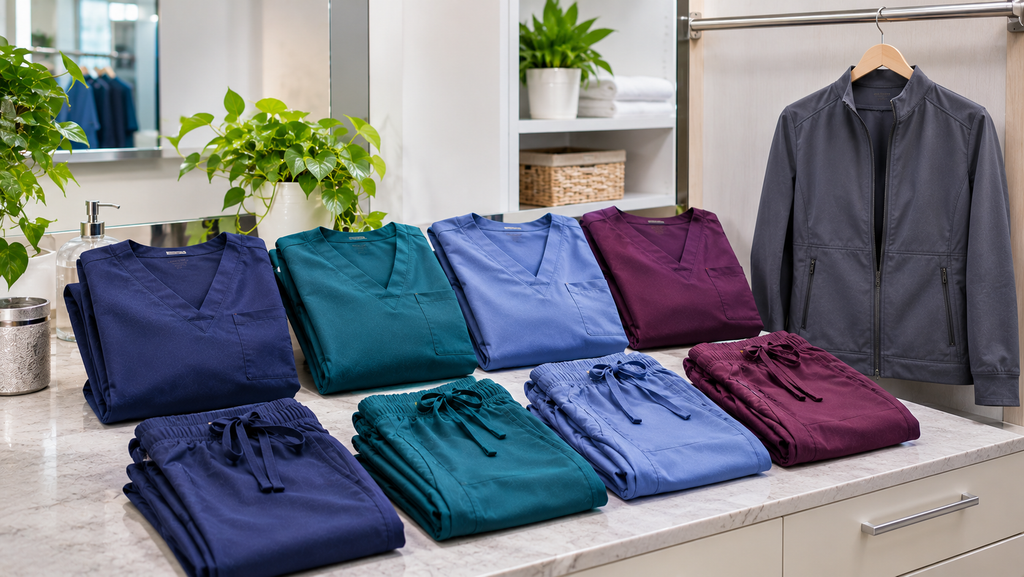
A useful foundation can include:
Everyday Scrub Sets
These should be the garments you know fit comfortably and meet your workplace requirements.
Backup Sets
Keep additional sets available for unexpected situations.
Alternative Pants
Different silhouettes can accommodate different preferences and activities.
Additional Tops
Extra tops can be useful when a top becomes soiled while the pants remain clean.
Approved Jackets
A lightweight jacket can provide additional coverage in cooler clinical environments.
Appropriate Color Options
If your workplace permits multiple colors, a small rotation can add variety without making the wardrobe unnecessarily large.
Should You Buy Complete Sets or Separate Tops and Pants?
Both approaches can work.
Complete sets make purchasing simple and ensure that the pieces are designed to work together.
Buying tops and pants separately provides greater flexibility.
For example, you may prefer:
- One particular pant silhouette
- Multiple top styles
- Different colors
- Different sizes between tops and bottoms
- A different fit for different workdays
Separate pieces can therefore be particularly useful when your body proportions or style preferences do not fit neatly into standard matching sets.
Why Is Fit More Important Than Having Many Styles?
A wardrobe with ten different styles is not particularly useful if only two of them are consistently comfortable.
Start by identifying the characteristics that work for you.
Consider:
- Shoulder fit
- Chest room
- Waistband comfort
- Rise
- Thigh room
- Inseam
- Leg shape
- Sleeve length
- Pocket placement
Once these characteristics are known, future purchases become easier.
The objective should be to build a wardrobe around repeatable fit preferences, rather than experimenting with a completely different silhouette every time.
How Should You Choose Scrub Tops?
Scrub tops should provide enough room for normal movement without creating unnecessary bulk.
Consider:
- Neckline
- Sleeve length
- Shoulder width
- Chest fit
- Side or hem shape
- Pocket configuration
- Fabric stretch
Different necklines can also change the overall appearance.
V-neck, crew-neck, mock-wrap, and other designs may suit different preferences while still providing appropriate clinical coverage.
Professionals looking for medical scrub tops should therefore evaluate both the cut and the fabric rather than selecting a top based only on color or appearance.
How Should You Choose Scrub Pants?
Pants need to support movement throughout the workday.
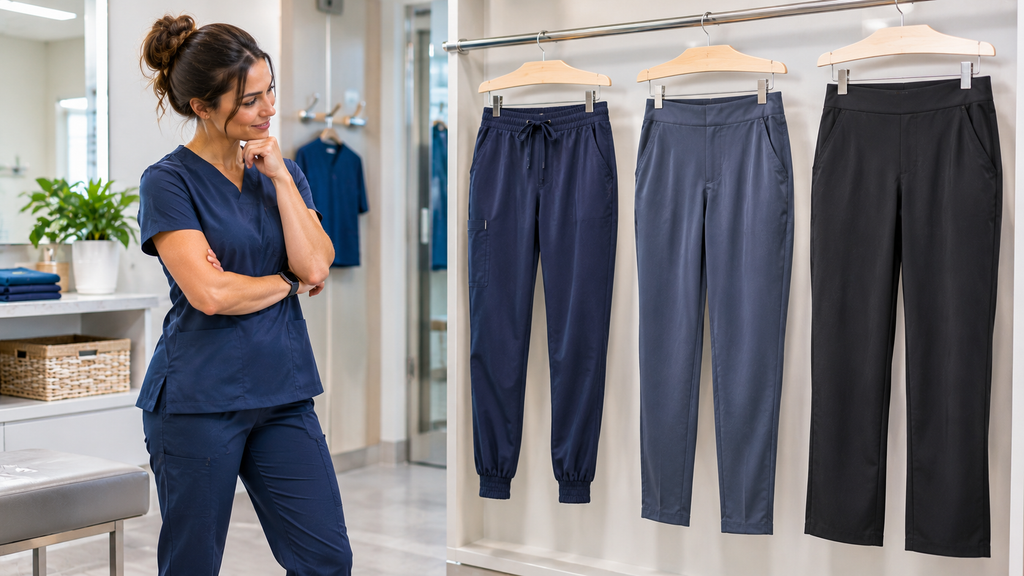
Evaluate:
- Waistband
- Rise
- Inseam
- Thigh room
- Knee mobility
- Leg shape
- Ankle opening
- Pocket placement
Common silhouettes include:
- Straight leg
- Tapered leg
- Jogger
- Wide leg
- Flare
- Relaxed fit
The best choice depends on body proportions, work activity, personal preference, and workplace requirements.
Should Your Scrub Pants and Tops Be the Same Size?
Not necessarily.
People often have different sizing requirements for tops and pants.
A professional may need:
- A larger top for shoulder room
- A smaller pant waist
- A longer pant inseam
- Different fits for different silhouettes
When buying separate pieces, prioritize the fit of each garment rather than forcing both pieces into one standard size.
How Many Scrub Tops Should You Own?
This depends on how frequently tops are changed and how often laundry is done.
A practical wardrobe may contain slightly more tops than pants because tops can become soiled independently of the pants.
For example, having an extra top available can be useful if:
- A spill occurs
- A patient-care task soils the garment
- The workday becomes unexpectedly long
- The top requires separate laundering
- You want additional color or style options
The exact number should reflect your actual work routine.
How Many Scrub Pants Should You Own?
Start with enough pants to cover your regular shifts, then add a small backup supply.
Pants generally experience repeated movement around the waist, hips, knees, and seat, so rotating several pairs can be useful.
Consider keeping at least one additional pair available beyond the number needed for a normal workweek.
How Important Is Fabric When Building a Scrub Wardrobe?
Fabric can determine how comfortable a uniform feels after several hours of wear.
Consider:
- Stretch
- Breathability
- Weight
- Durability
- Shape retention
- Moisture behavior
- Ease of care
A professional who walks continuously may prefer a lightweight fabric with useful stretch, while someone working in a cool environment may prefer a somewhat more substantial material.
There is no universally best fabric.
The goal is to match the fabric to the working conditions.
Should You Choose Stretch Scrubs?
Stretch can be valuable for healthcare professionals who frequently bend, reach, sit, stand, or walk.
A fabric containing elastane or spandex can provide additional flexibility.
However, more stretch is not automatically better.
The fabric should also provide adequate recovery and structure so the garment maintains its intended fit.
A useful wardrobe can therefore include stretch medical scrubs that provide mobility without feeling excessively loose or unstable.
How Important Is Breathability?
Breathability can become increasingly important during active shifts.
A professional who spends much of the day walking may become warm even in a relatively cool clinical environment.
A breathable fabric can help improve comfort by allowing heat and moisture vapor to move through the garment.
However, breathability depends on the complete fabric construction rather than the fiber name alone.
Should Scrubs Be Lightweight?
Lightweight scrubs can be useful when:
- The workplace is warm
- The job involves substantial movement
- Multiple layers are unnecessary
- The wearer prefers low-bulk clothing
A lightweight wardrobe can also make layering easier because the base uniform does not already feel heavy.
However, professionals working in consistently cool environments may want a combination of lightweight uniforms and appropriate layering pieces.
Why Should You Have More Than One Scrub Style?
Different styles can serve different purposes.
For example:
Joggers may provide a contemporary, tapered silhouette.
Tapered pants can offer a streamlined appearance without an aggressively cuffed ankle.
Straight-leg pants may provide a more traditional uniform appearance.
Wide-leg pants can provide a different silhouette and amount of lower-leg room.
Similarly, scrub tops can vary in neckline, sleeve construction, fit, and pocket arrangement.
A small amount of variety can make the wardrobe more adaptable without making it unnecessarily complicated.
Should Your Scrubs All Be the Same Color?
That depends on workplace policy.
Some healthcare facilities require specific colors for particular roles or departments. Others allow greater flexibility.
If multiple colors are permitted, a practical strategy is to establish a small core palette.
For example, you could maintain:
- One primary work color
- One secondary color
- One alternative color
- Matching or compatible layering pieces
A limited color palette also makes it easier to mix and match separate tops and pants.
How Can You Create a Mix-and-Match Scrub Wardrobe?
A mix-and-match system can increase wardrobe flexibility without requiring a large number of garments.
Start with compatible colors and consistent silhouettes.
For example:
- Three pants
- Four tops
- One jacket
can create more outfit combinations than three complete matching sets.
However, color compatibility should never override workplace requirements.
If your facility requires specific matching colors or sets, follow that policy.
How Should Men Build a Practical Scrub Wardrobe?
Men may benefit from starting with versatile scrub tops and pants that provide enough room through the shoulders, chest, waist, seat, and thighs.
A practical men’s wardrobe can include:
- Multiple everyday scrub tops
- Several pairs of preferred scrub pants
- At least one alternative pant silhouette
- A backup set
- An appropriate jacket or layering piece
Men’s medical scrubs are available in different leg shapes and waistband constructions, so the same principles of fit and movement apply when building a wardrobe.
How Should Women Build a Practical Scrub Wardrobe?
Women’s scrub wardrobes may include a wider range of silhouettes and fit preferences.
Useful categories can include:
- V-neck tops
- Mock-wrap tops
- Crew-neck tops
- Jogger pants
- Yoga-waist pants
- Tapered pants
- Wide-leg pants
- Jackets
The important consideration is not having every style but identifying the silhouettes that consistently fit and perform well.
A practical rotation of women’s medical scrubs can then be built around those preferred styles.
How Should Nurses Build a Scrub Wardrobe?
Nurses often spend substantial portions of their shifts walking, standing, bending, reaching, and assisting patients.
A practical nursing wardrobe should therefore prioritize:
- Mobility
- Comfortable waistbands
- Useful pockets
- Appropriate fabric stretch
- Breathability
- Easy care
- Durable construction
Having backup uniforms is also particularly useful when unexpected spills or extended shifts occur.
How Should Physicians Build a Scrub Wardrobe?
Physicians may have different requirements depending on their specialty and work environment.
Some may spend much of the day in clinical settings, while others move between examination rooms, offices, and consultation areas.
A physician’s wardrobe may therefore emphasize:
- Professional appearance
- Comfortable movement
- Practical storage
- Versatile layering
- Easy care
A smaller rotation of highly versatile pieces may be sufficient for some physicians.
How Should Medical Students Build a Scrub Wardrobe?
Medical students often move between different clinical environments.
Their schedules can also change from one rotation to another.
A practical wardrobe can therefore prioritize versatility.
Useful choices include:
- Neutral or approved colors
- Comfortable everyday tops
- Versatile pants
- One or two backup sets
- A lightweight layering piece
Because students may have different requirements across rotations, it is important to confirm the dress code before purchasing large quantities.
How Should You Build a Scrub Wardrobe for Long Shifts?
Long shifts place greater emphasis on comfort.
Consider building your rotation around:
- Stretch
- Breathability
- Comfortable waistbands
- Appropriate inseams
- Lightweight construction
- Functional pockets
A garment that feels comfortable for two hours may not remain comfortable after ten or twelve hours.
When possible, test your preferred styles during a full workday before buying multiple pieces.
Should You Own Different Scrubs for Different Seasons?
It can be useful if your workplace temperature changes significantly.
A seasonal wardrobe might include:
Warmer Conditions
- Lightweight scrub tops
- Breathable fabrics
- Lightweight pants
- Minimal layering
Cooler Conditions
- Slightly more substantial fabrics
- Approved scrub jackets
- Layering pieces
- Long-sleeve base layers when permitted
The exact requirements depend on the facility and local climate.
How Should You Build a Scrub Wardrobe for a Cold Hospital?
A cold clinical environment does not necessarily require heavy scrubs.
Layering can be more flexible.
A practical system can include:
- Lightweight base scrubs
- One or more approved scrub jackets
- Appropriate underscrubs
- Comfortable long-sleeve layers where permitted
This allows the wearer to adjust clothing as temperatures change throughout the day.
What Should You Look for in a Scrub Jacket?
A jacket should layer comfortably over the scrub top without restricting the shoulders.
Consider:
- Weight
- Stretch
- Breathability
- Sleeve length
- Closure
- Pockets
- Jacket length
A lightweight jacket can be especially useful when only modest additional warmth is needed.
How Many Scrub Jackets Do You Need?
Usually fewer than tops or pants.
One or two well-fitting jackets may be enough for many professionals.
Additional jackets may be useful when:
- Multiple colors are required
- Different departments have different requirements
- The jacket is worn every day
- Laundry frequency makes rotation necessary
- Seasonal conditions vary
Because jackets are generally an additional layer rather than the entire uniform, they do not necessarily need to match the number of scrub sets.
How Important Are Pockets?
Pocket design should reflect actual work requirements.
Useful pockets should be:
- Easy to access
- Secure
- Appropriately sized
- Positioned where they do not interfere with movement
Avoid selecting a garment simply because it has the largest number of pockets.
Carrying too many items can pull down the garment and affect comfort.
How Should You Organize Scrubs for the Workweek?
A simple system can make getting ready easier.
One approach is to prepare complete outfits in advance.
For example:
Monday: Top + pant + approved jacket
Tuesday: Top + pant
Wednesday: Top + pant + alternative jacket
Thursday: Top + pant
Friday: Top + pant
This can reduce daily decision-making and make it easier to identify when the laundry rotation needs attention.
How Can You Make Laundry Easier?
Separate scrubs according to the manufacturer’s care instructions and workplace requirements.
Before purchasing a large number of uniforms, check:
- Washing instructions
- Drying instructions
- Temperature requirements
- Ironing restrictions
- Special care requirements
The Federal Trade Commission requires care instructions for covered textile apparel, making the care label an important source of information when maintaining garments. FTC Care Labeling Requirements
How Does Frequent Washing Affect Scrubs?
Repeated laundering can eventually affect:
- Color
- Elasticity
- Fabric surface
- Shape
- Seams
- Finishing
This makes rotation particularly useful.
Instead of repeatedly washing one or two favorite uniforms, distributing wear across several garments can help create a more manageable wardrobe cycle.
Always follow the garment’s care instructions.
Should You Buy Expensive Scrubs?
Price alone should not determine whether a scrub belongs in your wardrobe.
Instead, evaluate:
- Fit
- Fabric
- Construction
- Durability
- Care requirements
- Functionality
- Workplace suitability
A moderately priced garment that consistently fits well and performs properly may be more useful than a more expensive garment that does not suit your work routine.
How Can You Avoid Overbuying Scrubs?
A common mistake is buying several garments before determining which styles actually work.
Instead:
- Identify your required work colors.
- Buy a small number of styles.
- Wear them through actual shifts.
- Evaluate comfort and durability.
- Identify the best-performing garments.
- Expand the rotation around those preferences.
This approach reduces the chance of filling a wardrobe with garments that rarely get worn.
How Should You Replace Old Scrubs?
Replace garments when their condition begins to affect comfort, appearance, or functionality.
Signs may include:
- Persistent fabric thinning
- Damaged seams
- Broken closures
- Excessive fading
- Loss of elasticity
- Permanent stains
- Significant shape distortion
Replacement timing depends on how frequently the garment is worn and laundered.
How Can You Make Scrubs Last Longer?
Good garment care can help preserve a scrub wardrobe.

Useful practices include:
- Follow care-label instructions.
- Avoid unnecessarily harsh washing conditions.
- Do not overload the washing machine.
- Dry according to manufacturer instructions.
- Address stains promptly according to appropriate care guidance.
- Rotate garments instead of repeatedly wearing the same set.
- Store garments clean and dry.
The manufacturer’s care instructions should always take priority over generic laundry advice.
How Can You Build a Scrub Wardrobe Around Fit?
Fit should be treated as the foundation.
Start by identifying:
Top Fit
- Shoulder width
- Chest room
- Sleeve length
- Torso length
Pant Fit
- Waist
- Rise
- Seat
- Thigh
- Inseam
- Leg opening
Layering Fit
- Jacket shoulder room
- Sleeve length
- Chest space
- Jacket length
Once these measurements and preferences are established, purchasing becomes much more predictable.
Should You Mix Different Scrub Brands?
You can, provided the garments meet your workplace requirements and work together comfortably.
Mixing brands can be useful when:
- One brand has better pants
- Another has preferred tops
- Different body proportions require different cuts
- A particular fabric works better for your job
However, color shades can vary between manufacturers, so professionals who need exact color matching should check the actual garments rather than relying only on color names.
How Should You Choose Scrubs for Professional Appearance?
A professional appearance generally comes from:
- Correct sizing
- Appropriate coverage
- Clean garments
- Consistent color
- Proper fit
- Well-maintained fabric
- Workplace-appropriate styling
The most expensive or fashionable uniform is not necessarily the most professional.
A well-fitting, clean, functional scrub set will generally provide a more polished appearance than an ill-fitting garment with premium branding.
Practical Scrub Wardrobe Checklist
Core Wardrobe
- Enough complete sets for your normal schedule
- One or two backup sets
- Preferred everyday tops
- Preferred everyday pants
Fit
- Correct top size
- Correct pant size
- Appropriate inseam
- Comfortable waistband
- Adequate shoulder and thigh room
Fabric
- Suitable weight
- Appropriate stretch
- Comfortable breathability
- Durable construction
- Manageable care requirements
Function
- Useful pockets
- Appropriate closures
- Comfortable movement
- Compatible layering
Workplace
- Approved colors
- Appropriate styles
- Department-specific requirements
- Separate PPE when required
Key Takeaways
Building a practical scrub wardrobe is less about owning a large number of uniforms and more about having the right combination of reliable, comfortable, work-appropriate pieces.
Keep these principles in mind:
- Start with your work schedule: The number of shifts determines your minimum rotation.
- Keep backups: Unexpected stains, schedule changes, and laundry delays happen.
- Prioritize fit: A comfortable garment you actually wear is more valuable than a larger collection of experimental styles.
- Choose fabrics for your work environment: Activity, temperature, and laundering requirements all matter.
- Use variety strategically: Different pant silhouettes or top styles can serve different preferences.
- Think about layering: One or two appropriate jackets can make a wardrobe more adaptable.
- Consider pockets carefully: Storage should support the job without creating unnecessary weight.
- Follow workplace requirements: Color and garment policies should guide purchases.
- Maintain garments properly: Care instructions can help preserve fabric, color, elasticity, and construction.
- Buy intentionally: Expand the wardrobe around styles that have already proven useful.
Frequently Asked Questions
How many scrubs should a healthcare professional own?
The number depends on the work schedule and laundry routine. A professional working five days per week may want at least five complete sets plus one or two backups, while someone working fewer shifts may need less. The goal is to have enough garments to cover the schedule without relying on emergency laundry.
Should scrub tops and pants match?
They do not always need to match exactly. If workplace policy allows separate colors and styles, buying tops and pants separately can create a more flexible wardrobe. However, some facilities require specific color combinations or uniform styles.
How many scrub tops should I own?
A practical wardrobe may contain as many or slightly more tops than pants because tops can become soiled independently of the pants. The appropriate number depends on work frequency, laundry habits, and whether the workplace permits separate top and pant combinations.
Are stretch scrubs better for long shifts?
Stretch can improve mobility during long shifts, particularly when the job involves frequent bending, reaching, walking, and sitting. However, the amount of stretch should be balanced with fabric recovery, structure, and proper garment fit.
Should I buy expensive medical scrubs?
Not necessarily. Price does not guarantee that a garment will fit your body or suit your work environment. Evaluate fit, fabric, construction, durability, care requirements, and workplace compatibility before considering price alone.
How often should scrubs be replaced?
There is no universal replacement schedule. Replace garments when their condition begins to affect comfort, appearance, or functionality. Persistent damage, excessive fading, stretched elastic, broken closures, permanent stains, and significant fabric deterioration are common reasons to replace a garment.
Can I wear the same scrub wardrobe year-round?
You can if the garments and layering options are suitable for your environment. Professionals working in areas with substantial seasonal temperature changes may benefit from combining lightweight base scrubs with appropriate jackets or other approved layers.
Conclusion
A practical scrub wardrobe should make healthcare work easier, not create another daily decision-making problem. The most effective approach is to build a reliable rotation around the garments that consistently fit well, provide the necessary mobility, meet workplace requirements, and remain comfortable throughout the shift.
Start with enough complete uniforms to cover the normal schedule, then add a small number of backup pieces. From there, build variety strategically through different tops, pants, fabrics, colors, or approved layering pieces rather than purchasing every available style.
Fabric deserves particular attention. Stretch, breathability, weight, durability, shape retention, and care requirements can all influence how a uniform performs after several hours of work and repeated laundering. The ideal fabric depends on the professional’s environment rather than on a universal ranking of materials.
Fit should remain the foundation. Whether selecting women’s medical scrubs or men’s styles, the right wardrobe is built around garments that provide appropriate shoulder, chest, waist, thigh, rise, inseam, and sleeve proportions.
Finally, workplace requirements should always come first. Some healthcare environments have specific rules for colors, uniform styles, laundering, and perioperative attire, while PPE requirements are separate from ordinary scrub clothing.
The best wardrobe is therefore not necessarily the biggest one. It is a well-planned rotation of comfortable, functional, durable, and workplace-appropriate scrubs that can reliably support the demands of every workday.