

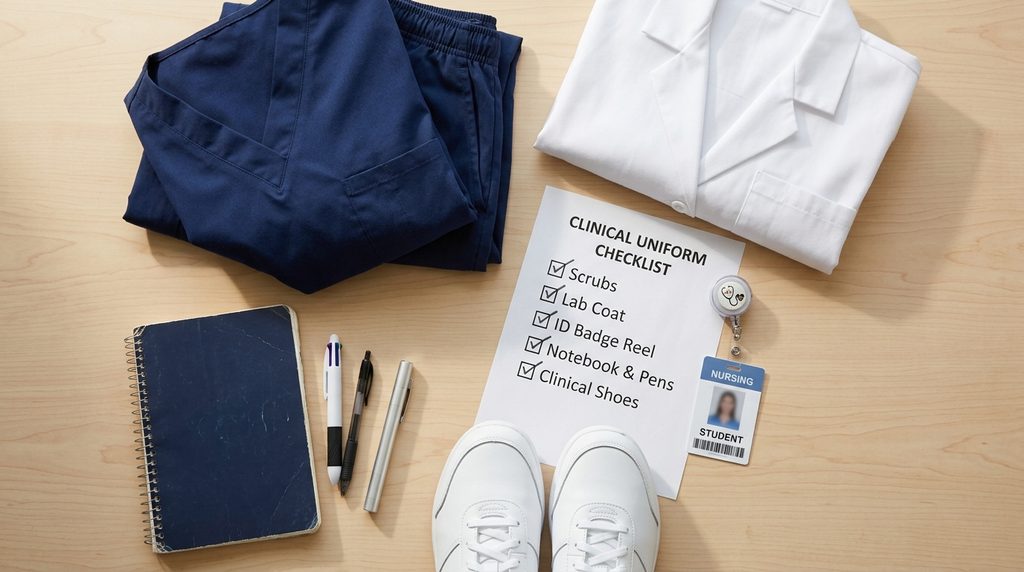
Nursing students need scrubs that meet program rules, fit comfortably, support clinical movement, and stay professional through repeated wear and laundering. The right uniform should match school requirements, clinical site expectations, assigned colors, lab coat rules, footwear guidelines, and the practical demands of patient-care training.
When choosing scrubs for nursing students, the first step is not style. Students should confirm the required color, embroidery, scrub top style, pant style, lab coat length, shoe requirements, and any clinical rotation restrictions before buying multiple uniform sets.
Quick Answer
Nursing students should choose scrubs based on school requirements first, then fit, fabric, comfort, laundering, and clinical movement. Most students need approved scrub tops and pants, a lab coat if required, comfortable clinical shoes, backup uniform pieces, and enough rotation to stay prepared for labs, skills practice, and clinical days.
Before buying, students should review the program handbook, ask about embroidery or patch placement, confirm approved colors, and check whether joggers, underscrubs, jackets, and specific lab coats are allowed.
Why Nursing Student Scrubs Need Careful Planning
Nursing school uniforms are not the same as casual workwear. Students may need to meet school rules, clinical site policies, instructor expectations, and professional appearance standards. A scrub set that feels comfortable may still be unusable if the color, style, embroidery, lab coat, or footwear does not meet requirements.
Clinical education often involves movement, standing, walking, patient-care practice, simulation labs, skills checkoffs, and professional interaction. The U.S. Bureau of Labor Statistics describes registered nurses as working in hospitals, physicians’ offices, home healthcare, nursing facilities, outpatient centers, and schools. That range of environments helps explain why nursing students need uniforms that support movement, comfort, and professional presentation during training. The BLS overview of registered nurse work environments offers useful context for the types of settings students may prepare for.
A good nursing school uniform plan can help with:
- Meeting program dress code rules
- Avoiding last-minute uniform problems
- Staying comfortable during long clinical days
- Keeping a professional student appearance
- Managing laundry between classes and rotations
- Preparing backup pieces for spills or schedule changes
- Supporting movement during labs and patient-care practice
- Coordinating scrub tops, pants, lab coats, and shoes
The goal is to build a practical student uniform setup before clinical schedules become demanding.
Start With the Nursing Program Handbook
Every nursing program may have its own uniform rules. Students should review the program handbook, orientation packet, clinical checklist, or instructor guidance before purchasing scrubs.
Details Students Should Confirm First
Before buying uniforms, students should check:
- Required scrub color
- Approved scrub top style
- Approved scrub pant style
- Whether joggers are allowed
- Whether scrub jackets are allowed
- Whether underscrubs are allowed
- Required lab coat length
- Patch or embroidery placement
- Name badge requirements
- Shoe color and shoe type rules
- Sock requirements
- Clinical site restrictions
- Skills lab uniform rules
- Grooming and professional appearance standards
Some programs require exact colors or specific embroidery. Others may allow several approved styles as long as the uniform looks professional and consistent.
How Many Scrub Sets Do Nursing Students Need?
The right number of scrub sets depends on class schedule, clinical rotation frequency, lab requirements, laundry routine, and budget. Students should avoid buying too many pieces before confirming program requirements, but they should also avoid having too few.
Basic Student Uniform Plan
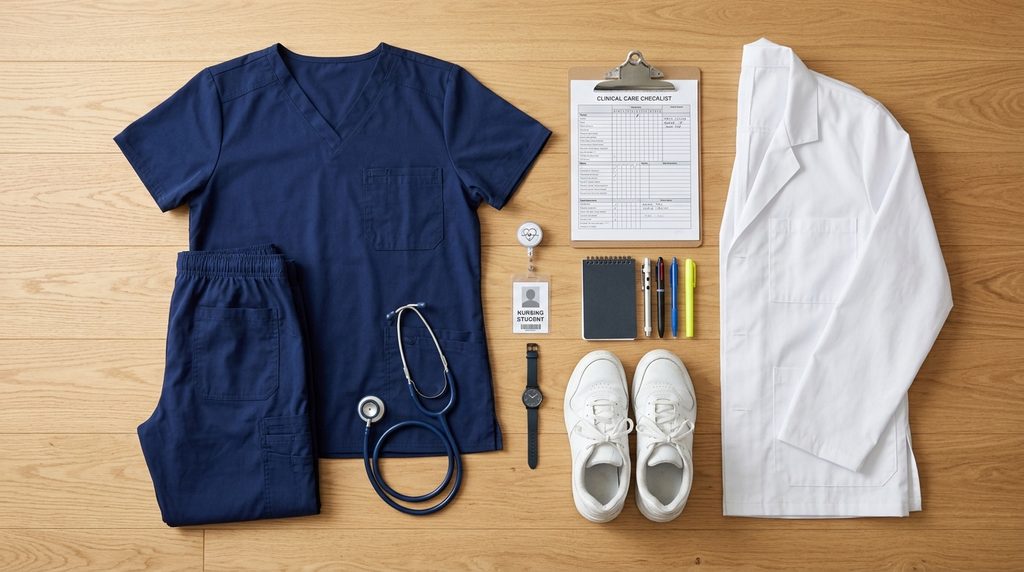
A practical starting point may include:
- 2 to 3 approved scrub tops
- 2 to 3 approved scrub pants
- 1 backup scrub set
- 1 required lab coat
- 1 to 2 approved underscrubs if allowed
- 1 approved scrub jacket if allowed
- Comfortable clinical shoes
- Extra socks
- Name badge and badge holder
- Small notebook and pens
Students with multiple clinical days per week may need more. Students with limited laundry access should also plan extra sets.
Why Backup Scrubs Matter
Backup scrubs are useful because clinical schedules can be strict. Spills, weather, laundering delays, sizing changes, or forgotten items can create stress before a clinical day. Having one extra approved set can prevent last-minute problems.
Choosing Nursing Student Scrub Tops
Scrub tops should meet school rules and allow movement during labs and clinical care. Students should avoid choosing tops based only on appearance. Fit, length, pockets, neckline, sleeve comfort, and laundering performance matter.
Fit Through the Shoulders and Chest
A nursing student scrub top should allow reaching, bending, turning, and practicing care skills without pulling across the shoulders or chest. A top that is too tight may restrict movement, while a top that is too loose may look unprofessional or get in the way.
Students should test scrub tops by:
- Reaching forward
- Raising both arms
- Bending slightly
- Sitting and standing
- Wearing the top with scrub pants
- Layering under a lab coat if required
- Checking coverage during movement
Top Length
Top length should provide coverage while bending or reaching. However, a top that is too long can look bulky or interfere with scrub pants. Petite students may need a shorter top, while taller students may need more length.
Pockets
Pockets can be useful for pens, notes, clinical tools, and small essentials. However, students should avoid overloading pockets because heavy items can pull on the garment or look messy.
Useful top pocket features may include:
- Chest pocket
- Pen slot
- Side-entry pockets
- Badge loop
- Small utility pocket
Students should also confirm whether their clinical site allows certain items to be carried in pockets.
Choosing Nursing Student Scrub Pants
Scrub pants should fit securely, move comfortably, and meet program rules. Students should confirm whether the school allows joggers, cargo pants, tapered pants, or only traditional straight-leg pants.
Waistband Comfort
The waistband should stay secure without rolling, digging, or sliding. Students may spend hours standing, walking, sitting in post-conference, practicing skills, or moving between clinical areas.
Common waistband options include:
- Elastic waistband
- Drawstring waistband
- Elastic-and-drawstring waistband
- Knit waistband
- Yoga waistband
- Flat-front waistband
A drawstring can help adjust fit. A soft waistband may be useful for long clinical days.
Inseam and Pant Length
Pant length matters because hems should not drag or ride too high. Students should test pants with the exact shoes they plan to wear for clinicals.
Petite students may need shorter inseams. Tall students may need longer inseams. Students who choose joggers should make sure the cuff lands correctly near the ankle and that joggers are allowed by the program.
Pocket Placement
Pocket placement should be practical but not bulky. Cargo pockets can be helpful, but some programs may prefer cleaner pant styles. Students should check school rules before buying several pairs.
Lab Coats for Nursing Students
Many nursing programs require lab coats for skills labs, simulations, clinical rotations, professional events, or specific care settings. Students should confirm the required coat length, color, embroidery, and patch placement before buying.
When choosing lab coats for students, fit and function both matter. A lab coat should look professional, fit over scrubs, and allow shoulder and sleeve movement.
Lab Coat Fit
A student lab coat should:
- Fit comfortably over scrub tops
- Allow reaching and bending
- Button or close without pulling
- Have sleeves that do not cover the hands
- Provide enough pocket space
- Meet school length requirements
- Look neat after laundering
A coat that is too tight may restrict movement. A coat that is too large may look bulky and interfere with patient-care practice.
Lab Coat Pockets
Lab coat pockets can help students carry pens, small notes, clinical paperwork, or approved tools. Students should avoid overfilling pockets, especially in patient-care environments where organization and cleanliness matter.
Embroidery and Patch Rules
Some nursing programs require embroidered names, school logos, patches, or specific placement. Students should not add embroidery until they confirm exact spelling, credentials, school format, and placement instructions.
Footwear and Uniform Completeness
Scrubs are only one part of a nursing student uniform. Shoes, socks, name badges, hair rules, jewelry rules, and grooming standards may all be part of the program dress code.
Shoes
Clinical shoes should meet program requirements and provide enough support for standing and walking. Some schools require white, black, leather-like, closed-toe, or non-mesh shoes. Others have more flexible guidelines.
Students should confirm:
- Approved shoe color
- Closed-toe requirements
- Slip-resistance expectations
- Whether mesh shoes are allowed
- Whether logos are restricted
- Whether shoes must be wipeable
- Sock color rules
Footwear should be tested before the first long clinical day.
Name Badge and Student Identification
Most programs require a school-issued badge or clinical identification. Students should wear it according to school and clinical site rules.
Underscrubs and Layers
Some students wear underscrubs for warmth or coverage. These should be approved by the program. Students should confirm allowed colors, sleeve length, and whether visible layers are permitted.
Fabric Features for Nursing Student Scrubs
Fabric affects comfort, movement, laundering, and durability. Nursing students may wear the same few uniforms repeatedly, so fabric performance matters.
Stretch
Stretch helps scrubs move during skills practice, patient care, bending, reaching, and walking. It can improve comfort during long clinical days.
Breathability
Breathable fabric can help students stay comfortable in warm labs, busy clinical settings, or during active shifts.
Durability
Student scrubs may be washed often. Durable fabric should hold up to repeated laundering, movement, and regular wear.
Easy Care
Easy-care fabric is helpful because students often balance classes, clinicals, studying, assignments, and laundry. Scrubs that resist heavy wrinkling and maintain shape can reduce weekly stress.
The CDC provides guidance on healthcare laundry and bedding, including cleaning considerations for healthcare textiles. Students should follow program policies, clinical site rules, garment labels, and any infection-control requirements that apply.
Scrubs for Skills Lab vs Clinical Rotations
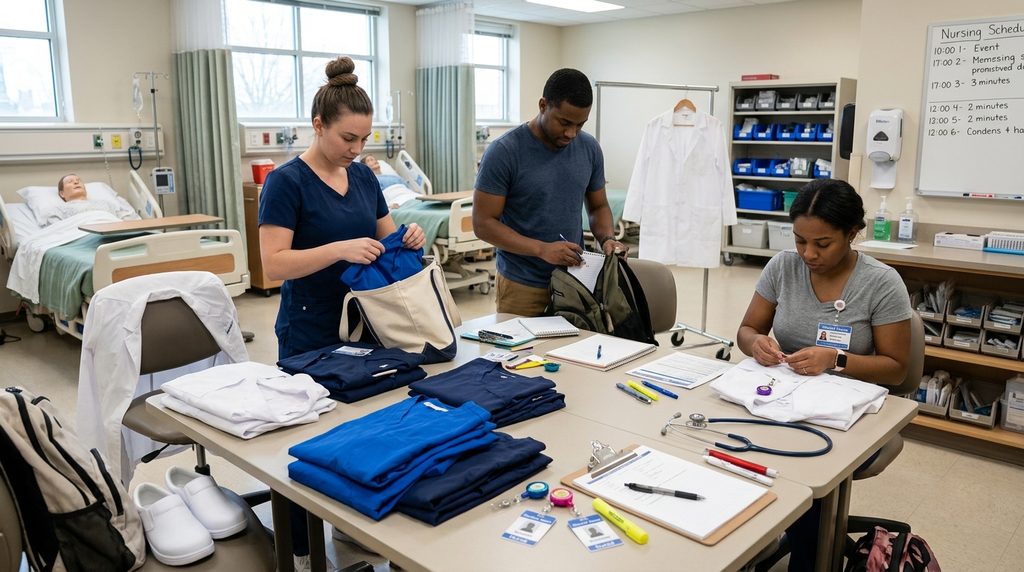
Some nursing programs use the same uniform for skills lab and clinical rotations. Others may have separate expectations for classroom labs, simulation, and patient-care sites.
Skills Lab
Skills lab uniforms should support movement, kneeling, bending, reaching, and repeated practice. Comfort matters because students may perform assessments, transfers, injections on models, bed-making, mobility practice, and equipment handling.
Simulation Lab
Simulation labs often require professional appearance because students practice real-world scenarios. The uniform should be clean, complete, and consistent with program requirements.
Clinical Rotations
Clinical rotations may have stricter requirements because students enter real healthcare environments. Students should confirm site-specific policies before each placement.
Some sites may have extra rules about:
- Scrub color
- Lab coat use
- Badge visibility
- Footwear
- Jewelry
- Jackets
- Underscrubs
- Personal items
- Infection-control procedures
Scrub Fit Tips for Nursing Students
A student scrub uniform should be comfortable enough for movement and professional enough for clinical evaluation. Fit problems can become distracting during long days.
Petite Students
Petite students may need shorter pants, smaller top lengths, or better sleeve proportions. Regular pants that are hemmed may still have poorly placed pockets or knee areas.
Tall Students
Tall students may need longer inseams, longer tops, or lab coats with better sleeve length. Pants should not ride too high when sitting.
Students Between Sizes
Students between sizes should test movement carefully. Sizing up may improve comfort, but too much extra fabric can look oversized. Sizing down may look cleaner, but it should not restrict bending, sitting, or reaching.
Jogger Fit
Joggers can be comfortable, but students should confirm they are allowed. The ankle cuff should sit correctly and should not ride too high during sitting.
What to Bring When Shopping for Nursing School Scrubs
Students can make uniform shopping easier by bringing key information before visiting a medical scrub store.
Helpful details include:
- Program handbook or uniform checklist
- Required scrub color
- Required lab coat details
- Embroidery or patch instructions
- Approved shoe rules
- Clinical start date
- Sizing concerns
- Preferred fit notes
- School contact information if requirements are unclear
A verified West Chester medical scrub store listing can help local shoppers confirm store details and directions before visiting.
How to Plan a Nursing Student Uniform Budget
Nursing school expenses can add up, so students should plan carefully. Buying the right pieces first is better than buying too many items that may not meet requirements.
Prioritize Required Pieces
Students should buy required items first:
- Approved scrub tops
- Approved scrub pants
- Required lab coat
- Required shoes
- Name badge holder
- Approved underscrub if needed
- Backup set when possible
Avoid Buying Too Much Too Soon
Before buying multiple sets, students should confirm fit, color, school rules, and clinical site expectations. Starting with a few approved pieces and adding more after fit is confirmed can reduce waste.
Plan for Replacement
Students may need to replace scrubs if they fade, shrink, stain, or no longer fit. A backup set can help extend the life of the main uniform rotation.
Caring for Nursing Student Scrubs
Nursing students should keep uniforms clean, ready, and organized. Clinical days often start early, so uniforms should be prepared in advance.
Good care habits include:
- Washing scrubs after wear
- Following garment labels
- Treating stains before drying
- Emptying pockets before laundering
- Hanging or folding scrubs promptly
- Keeping lab coats clean and pressed if needed
- Keeping shoes clean
- Preparing the full uniform the night before clinical
- Checking badge, pens, and required items in advance
A clean and complete uniform supports professionalism and helps avoid unnecessary stress before class or clinical.
Uniforms, PPE, and Safety Rules
Scrubs and lab coats are professional apparel, but they are not replacements for required personal protective equipment. OSHA explains that personal protective equipment helps reduce exposure to workplace hazards that may cause injuries or illnesses.
Depending on the clinical setting, students may need gloves, gowns, masks, eye protection, respirators, or other PPE. Nursing students should follow school, instructor, and clinical site policies for PPE use, uniform handling, and infection-control procedures.
Common Mistakes Nursing Students Should Avoid
Many student uniform issues happen because students buy before confirming requirements.
Avoid these mistakes:
- Buying scrubs before reading the program handbook
- Choosing the wrong color
- Adding embroidery before confirming instructions
- Buying joggers without checking if they are allowed
- Choosing pants that drag or ride too high
- Buying only one scrub set
- Forgetting a backup uniform
- Ignoring lab coat requirements
- Buying shoes that do not meet school rules
- Waiting until the week before clinicals
- Skipping laundering instructions
- Treating scrubs as a substitute for PPE
A little planning before purchasing can prevent expensive mistakes.
Final Thoughts
Nursing students should choose scrubs based on program rules first, then fit, comfort, fabric, movement, laundering, and weekly rotation. A practical student uniform plan includes approved scrub tops and pants, a lab coat if required, comfortable clinical shoes, backup pieces, and enough rotation for labs and clinical days.
Before buying, students should confirm color, style, embroidery, patch placement, lab coat length, footwear rules, and whether joggers, jackets, or underscrubs are allowed. The right uniform should help students look professional, stay comfortable, and remain prepared for the demands of nursing school and clinical rotations.
FAQs
How many scrub sets do nursing students need?
Many nursing students need 2 to 3 approved scrub sets plus one backup set. Students with multiple clinical days per week, limited laundry access, or strict lab schedules may need more. Program requirements should always be confirmed before buying several sets.
What scrubs should nursing students buy?
Nursing students should buy scrubs that match school color, style, fit, embroidery, and clinical requirements. Comfort matters, but program rules come first. Students should confirm whether joggers, jackets, underscrubs, and specific pant styles are allowed before purchasing.
Do nursing students need lab coats?
Some nursing programs require lab coats for skills labs, simulations, clinical rotations, or professional events. Students should confirm coat length, color, embroidery, patch placement, and pocket requirements before buying a lab coat.
Can nursing students wear jogger scrub pants?
Some programs allow jogger scrub pants, while others require traditional straight-leg or specific pant styles. Students should check the program handbook or ask an instructor before buying joggers for clinical use.
How should nursing school scrubs fit?
Nursing school scrubs should fit comfortably without pulling, dragging, sagging, or restricting movement. Tops should allow reaching and bending, while pants should stay secure at the waist and work with approved clinical shoes.