

Group scrub ordering can quickly become complicated when every staff member has different sizing needs, style preferences, department requirements, and payment arrangements. A clinic, dental office, veterinary practice, med spa, outpatient center, or healthcare team may want a consistent professional look, but staff members still need uniforms that fit comfortably during real work.
A good group uniform process should make it easier to choose approved colors, collect sizes, manage embroidery, handle staff payments, and support future reorders. For organizations planning group scrub ordering, the best approach is to combine team consistency with individual fit flexibility.
Quick Answer
Medical teams can simplify group scrub ordering by choosing approved colors first, selecting a small range of scrub styles, collecting accurate staff sizes, confirming embroidery needs, assigning a point person, setting payment rules, and using a repeatable ordering process for new employees.
A practical group uniform plan should include:
- Approved scrub colors
- Men’s and women’s fit options
- Petite, regular, tall, or short pant lengths
- Role-specific needs for nurses, assistants, doctors, dental staff, or veterinary teams
- Embroidery rules
- Logo and name placement
- Staff payment process
- Return and exchange expectations
- Reorder process for new hires
- Timeline for delivery and distribution
Why Group Scrub Ordering Needs a Clear Process
Ordering scrubs for one person is simple compared with ordering for a full team. One employee may prefer joggers. Another may need tall scrub pants. A third may need petite sizing. A provider may want a lab coat, while a medical assistant may need extra pockets. If the process is not organized, the final order can lead to wrong sizes, mismatched colors, delayed embroidery, and frustrated staff.
Healthcare teams usually need group scrubs for three reasons:
- Consistency: The team needs to look organized and professional.
- Function: Staff members need uniforms that work for their roles.
- Repeatability: New employees need to be added without restarting the process every time.
A clean ordering process helps avoid scattered staff purchases, inconsistent shades, missing embroidery, and confusion over who pays for what.
Start With the Uniform Policy
Before comparing styles, the team should define the uniform policy. This keeps the ordering process focused and prevents unnecessary choices.
What the policy should clarify
A group scrub policy should answer:
- What color or colors are allowed?
- Are different departments assigned different colors?
- Are men’s and women’s styles both allowed?
- Are joggers acceptable?
- Are underscrubs allowed?
- Should jackets match the scrub set?
- Are lab coats required for certain roles?
- Is embroidery required?
- Should names, credentials, or department names appear on the uniform?
- Who pays for the scrubs?
- How often can employees reorder?
The policy does not need to be complicated. It only needs to make buying decisions clear before staff members begin choosing styles.
Choose Team Colors Before Choosing Styles

Color is usually the first practical decision in group scrub ordering. Many healthcare teams choose one core color for all staff, while larger organizations may use department-specific colors.
Common approaches to scrub color planning
Single-color team uniforms
This is common for small clinics, dental offices, veterinary practices, med spas, and specialty care teams. Everyone wears the same approved color for a unified look.
Department-based color coding
This may work better for larger practices or multi-role healthcare settings. Nurses, medical assistants, front-office staff, providers, and technicians may each have different approved colors.
Role-based color flexibility
Some teams choose one main color but allow different jackets, lab coats, or underscrubs depending on role.
A team should choose colors that are easy to reorder. A color that looks good once but is difficult to find later can create consistency problems when new staff members are hired.
Keep Style Choices Flexible, But Controlled
The biggest mistake in group ordering is forcing every employee into one exact scrub style. A single style may not fit all body types or all roles. The second mistake is giving staff unlimited choices, which can make the team look inconsistent.
The best approach is usually controlled flexibility.
A controlled flexibility model
A healthcare team might approve:
- Two or three scrub top options
- Two or three pant styles
- One or two jacket options
- Approved men’s and women’s styles
- Approved petite, tall, short, and regular lengths
- One or two lab coat options, if needed
This gives staff members enough choice to find a comfortable fit while keeping the team visually consistent.
Account for Different Healthcare Roles
Not every staff member uses scrubs the same way. A good group scrub order should consider how each role works throughout the day.
Nurses and clinical assistants
Nurses, CNAs, and clinical assistants often need flexible fabrics, practical pockets, and pants that stay secure during movement.
Useful features include:
- Stretch fabric
- Cargo pockets
- Secure waistbands
- Breathable tops
- Comfortable pant lengths
- Matching jackets
Medical assistants
Medical assistants may move between patient rooms, front-office tasks, vitals, charting, and clinical support. They usually need polished scrubs that still offer movement and storage.
Useful features include:
- Professional fit
- Easy-care fabric
- Pockets for pens and notes
- Comfortable tops
- Coordinated jackets
Doctors and advanced practice providers
Doctors, physician assistants, and nurse practitioners may need scrubs, lab coats, or consultation coats depending on the work setting.
Useful features include:
- Clean silhouettes
- Professional fabrics
- Lab coat compatibility
- Simple pocket layouts
- Comfortable movement
Dental teams
Dental professionals often sit, lean, reach, and move between operatories. Uniforms should stay comfortable while seated and maintain a polished team appearance.
Useful features include:
- Stretch shoulders
- Smooth fabric
- Comfortable waistbands
- Embroidered tops
- Lightweight jackets
Veterinary teams
Veterinary staff may need scrubs that handle bending, lifting, cleaning, and contact with animal hair.
Useful features include:
- Durable fabric
- Easy-care materials
- Secure pockets
- Stretch and recovery
- Hair- and lint-conscious fabric choices
Build Sizing Into the Process Early

Sizing is one of the most important parts of group scrub ordering. A team order can go wrong quickly if sizes are collected casually or guessed from normal clothing sizes.
Better ways to collect sizes
Teams can reduce sizing problems by:
- Asking staff to try on sample sizes
- Using brand-specific size charts
- Separating top size from pant size
- Recording pant length separately
- Asking staff to confirm preferred fit
- Allowing time for exchanges before the uniform launch
- Avoiding bulk orders based only on small, medium, and large labels
Scrub brands can fit differently across shoulders, waist, hips, thighs, inseam, and rise. A staff member may wear one size in a classic fit but another size in an athletic or slim-fit collection.
Plan for Petite, Tall, Short, and Regular Lengths
Pant length is a common problem in group orders. Standard-length scrub pants will not work for everyone.
Why pant length matters
Scrub pants that are too long can drag on the floor, look unprofessional, and create discomfort. Pants that are too short may feel awkward or fail workplace expectations. Jogger pants may reduce dragging because of the cuffed ankle, but not every workplace allows joggers.
A good group order should include:
- Petite lengths
- Regular lengths
- Tall lengths
- Short lengths when available
- Jogger, straight-leg, cargo, or tapered options if approved
This is especially important for teams with a mix of heights and body types.
Decide on Embroidery Before Ordering
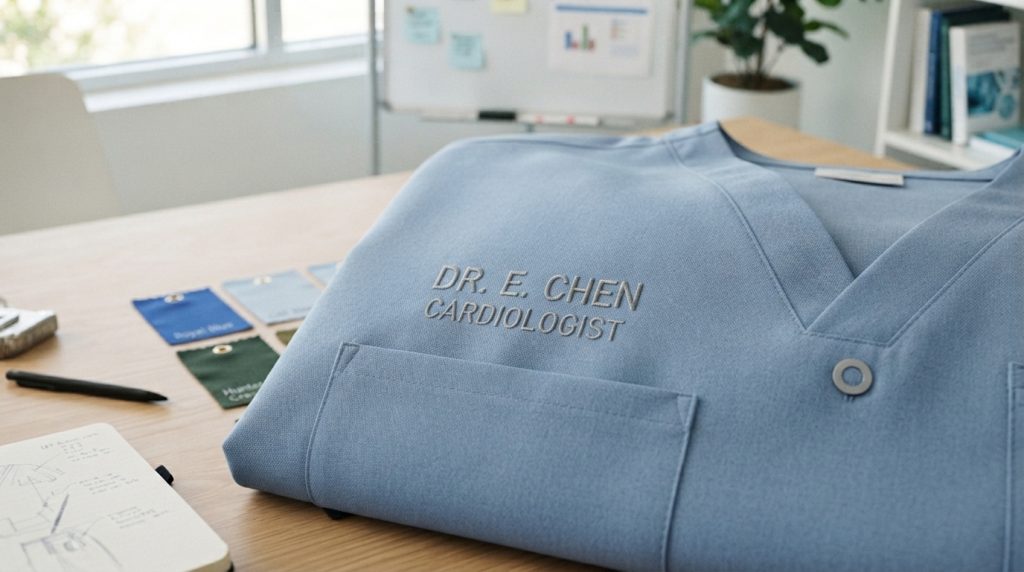
Embroidery can make uniforms look more professional, but it adds decisions that should be settled early. Teams exploring custom embroidered scrubs should confirm logo files, placement, thread color, employee names, credentials, and approval steps before the order is finalized.
Common embroidery decisions
A team should decide:
- Whether the company logo will be used
- Whether staff names will be included
- Whether credentials will appear
- Whether department names are needed
- Where embroidery will be placed
- Whether jackets and lab coats need embroidery
- Who approves the final embroidery proof
- Whether embroidery is required for all staff or only certain roles
Embroidery should be planned before garments are distributed. Adding it later can create delays and inconsistencies.
Understand Workplace Safety and Hygiene Context
Uniforms are only one part of a healthcare workplace. They do not replace infection control procedures, PPE, hand hygiene, laundering rules, or employer policies. Still, group uniforms should be selected with the work environment in mind.
The CDC’s guidance on standard precautions for infection control explains broader infection prevention practices used in healthcare settings. Uniform policies should align with employer rules and clinical safety expectations.
OSHA also provides general information on healthcare workplace safety, including hazards that may affect healthcare workers. Practical workwear should support movement and professionalism, but safety procedures should always come from workplace policy and applicable regulations.
Create a Payment and Approval System
Payment confusion can slow down group scrub ordering. Before the order is placed, the organization should decide whether uniforms are company-paid, employee-paid, or partially subsidized.
Common payment models
Company-paid uniforms
The organization pays for approved uniform items. This gives the employer more control over color, style, and presentation.
Employee-paid uniforms
Employees choose from approved options and pay for their own scrubs. This can work well when staff members prefer different fits or want extra sets.
Partial reimbursement
The employer covers a set amount, and employees pay for additional items or upgrades.
New-hire allowance
The organization provides a starting uniform allowance for new staff and sets reorder rules for future purchases.
The payment model should be clearly explained before staff begin selecting items.
Use a Central Point Person
Group orders work better when one person coordinates the process. Too many decision-makers can create confusion, especially with colors, logos, sizes, and deadlines.
The point person should manage:
- Approved color list
- Style options
- Staff sizing information
- Order deadline
- Embroidery approval
- Payment details
- Internal communication
- Delivery or pickup planning
- Reorder instructions
This person does not need to make every decision alone. Their role is to keep the process organized and prevent details from being lost.
Consider a Group Webstore or Repeat Ordering System
A group webstore can make the ordering process easier for teams that hire regularly or allow employees to purchase their own uniforms. Instead of sending staff through open-ended shopping pages, the organization can direct them to approved items.
A repeatable ordering system can help with:
- New employee onboarding
- Seasonal uniform refreshes
- Department consistency
- Approved colors
- Approved embroidery
- Staff self-ordering
- Reducing administrative time
- Avoiding outdated uniform choices
This is especially useful for growing clinics, multi-location teams, dental groups, veterinary practices, and healthcare offices with frequent hiring.
Confirm Timeline Before the Uniform Launch
Group scrub orders can take longer than individual purchases, especially if embroidery, special sizes, or staff payment collection is involved.
Timeline factors to check
Before setting a launch date, teams should consider:
- Staff sizing deadline
- Product availability
- Embroidery proof approval
- Embroidery production time
- Shipping or pickup timing
- Exchange window
- New-hire needs
- Internal distribution process
A uniform rollout should not be scheduled too tightly. Giving staff enough time to confirm size and make adjustments prevents rushed decisions.
Use Local Fit Support When Needed
Online ordering can be efficient, but in-person sizing can prevent mistakes. Local fit support is especially helpful when staff members are trying a new brand, switching from unisex to gender-specific sizing, or choosing between pant lengths.
Teams that prefer in-person sizing support can review a local medical uniform store profile before coordinating staff visits or pickup plans.
In-person support can be useful for:
- New employees
- Students
- Staff between sizes
- Petite or tall workers
- Teams trying a new scrub collection
- Employees comparing fabric feel
- Workers deciding between joggers, cargo pants, and straight-leg pants
Avoid Common Group Scrub Ordering Mistakes
Allowing too many style choices
Too many options can make the team look inconsistent. Keep choices flexible but limited.
Ignoring pant length
Pant length mistakes are common in group orders. Always collect inseam or length preference separately.
Waiting too long to approve embroidery
Embroidery requires logo files, proofing, and approval. Delayed approval can delay the full order.
Guessing staff sizes
Normal clothing size does not always match scrub size. Use samples, size charts, or fitting support whenever possible.
Forgetting new hires
A group uniform process should include future reorders. Otherwise, new employees may end up with mismatched scrubs.
Not explaining payment rules
Employees should know what is covered, what is optional, and when payment is due.
Final Group Scrub Ordering Checklist
Before placing a group order, a healthcare team should confirm:
- Approved scrub color
- Approved brands or collections
- Men’s and women’s style options
- Petite, regular, tall, and short-length needs
- Required scrub tops and pants
- Optional jackets or underscrubs
- Lab coat requirements
- Embroidery details
- Logo approval
- Name and credential rules
- Staff size list
- Payment model
- Order deadline
- Return or exchange expectations
- New-hire reorder process
- Delivery, pickup, or distribution plan
Teams that need medical uniforms for healthcare teams should treat uniform buying as a system, not a one-time order. A clear process helps staff look consistent, feel comfortable, and reorder approved uniforms without confusion.

FAQs
What is the best way to organize a group scrub order?
The best way is to choose approved colors first, limit style options, collect accurate sizes, confirm embroidery details, assign one point person, and set a clear deadline. A repeatable process also helps with future hires and reorders.
Should every employee wear the exact same scrub style?
Not always. Many teams look consistent by using the same color while allowing different approved fits. This helps employees choose scrubs that work for their body type, role, and pant length needs.
How early should a medical team start group scrub ordering?
Teams should start early enough to allow for sizing, product selection, embroidery proofing, payment collection, exchanges, and delivery. Extra time is especially important for new uniforms, large teams, special sizes, and logo embroidery.
What information is needed for embroidered scrubs?
Most embroidery orders need logo files, placement instructions, thread color, staff names, credentials, department names if applicable, and approval of an embroidery proof. These details should be finalized before garments are produced.
How can teams avoid sizing problems with group scrubs?
Teams can reduce sizing issues by using sample try-ons, brand-specific size charts, separate top and pant sizing, pant length selection, and a clear exchange process. Staff should avoid guessing sizes based only on casual clothing.