

The best scrub brand is not automatically the most popular, softest, or most expensive option. Healthcare professionals should choose scrubs by comparing how a brand or collection handles fit, fabric, pant length, pocket placement, movement, and daily care. When evaluating IRG scrubs, for example, it is more useful to examine the differences among available collections and styles than to assume every garment under one brand performs identically.
A strong scrub choice starts with the workday. Identify what the job requires, understand personal fit needs, and then find a brand or collection designed around those priorities.
Quick Answer
Choose a scrub brand by comparing six factors:
- Fit: Does the collection offer a suitable rise, cut, and silhouette?
- Length: Are petite, short, regular, or tall options available where needed?
- Fabric: Does the material match the preferred stretch, weight, and drape?
- Pockets: Are storage areas positioned for the items actually carried?
- Workday needs: Does the garment support frequent walking, sitting, reaching, or layering?
- Availability: Can the same collection support future replacement and additional uniform needs?
Do not ask only, “What is the best scrub brand?”
Ask:
Which scrub collection offers the right combination of fit, fabric, and function for my actual healthcare workday?
That question usually produces a more practical answer.
Why is choosing a scrub brand more complicated than it seems?
Scrub brands often contain multiple collections.
Those collections may use different:
- Fabrics
- Fiber blends
- Fits
- Waistbands
- Pant silhouettes
- Pocket configurations
- Size ranges
- Length options
- Design details
This means someone can like one collection from a manufacturer and dislike another.
For example, an official IRG collection page describes EPIC around tailored fits, functional pockets, and workday comfort, while the brand’s Edge collection is described around a lightweight fabric feel and modern styles.
The practical lesson is simple:
Compare collections, not just logos.
A brand name can help narrow the search, but the individual collection and garment determine the actual wearing experience.
Start with the healthcare role, not the scrub brand
Healthcare is a broad occupational field that includes professionals with very different daily duties. The U.S. Bureau of Labor Statistics groups numerous clinical, diagnostic, support, and practitioner occupations within healthcare, reinforcing how varied healthcare work can be.
A scrub selection process should begin with normal work activities.
Ask how much of the day involves movement
Consider whether the job involves frequent:
- Walking
- Sitting
- Standing
- Reaching
- Bending
- Moving between rooms
- Alternating between clinical and administrative tasks
A highly active worker may pay close attention to knee mobility, waistband stability, and pocket balance.
Someone working in a medical office may prioritize seated comfort and a polished silhouette.
Identify normal layering
Does the worker regularly wear:
- An underscrub
- A scrub jacket
- A lab coat
- Workplace-required protective clothing
A scrub top that feels comfortable alone can fit differently when layered.
The same applies to fabric weight. A heavier scrub top may be preferred by one person and feel excessive to someone who regularly wears multiple layers.
List actual storage needs
Before comparing brands, identify the approved work items normally carried.
Then ask:
- Is a chest pocket useful?
- Are two lower patch pockets needed?
- Would cargo pockets be practical?
- Is a zippered compartment important?
- Will heavy pocket loads pull on the garment?
Pocket quantity alone should not determine the brand choice.
How should scrub fit influence brand selection?
Fit is one of the strongest reasons to prefer one scrub collection over another.
The size label does not tell the whole story.
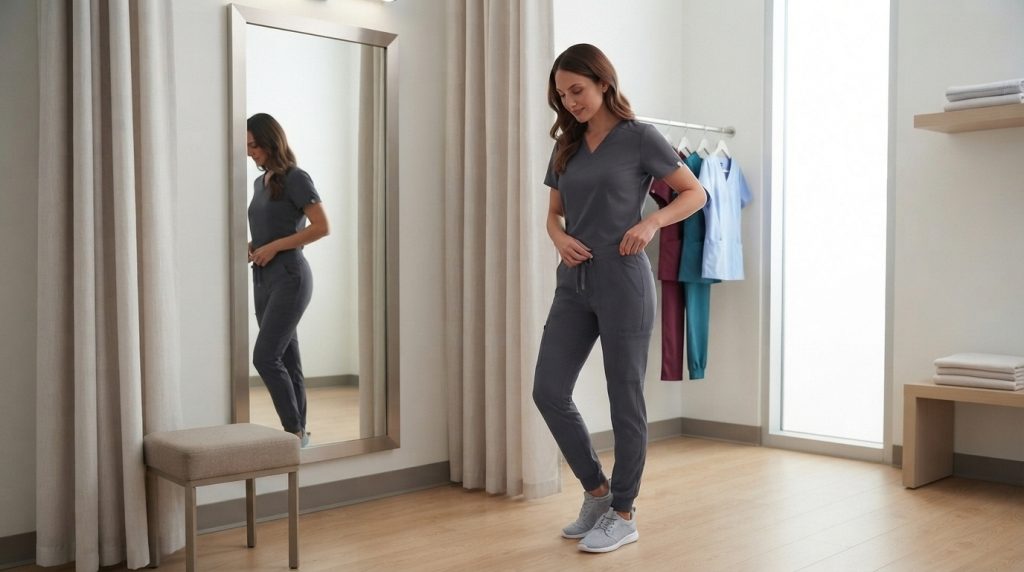
Two scrub tops marked medium can differ in:
- Shoulder width
- Chest room
- Waist shaping
- Sleeve opening
- Top length
- Neckline
- Overall silhouette
Scrub pants can differ even more.
Compare pant rise
Pant rise affects where the waistband sits and how the garment feels while sitting or bending.
A person who prefers a higher waistband may dislike a lower or shorter rise even when the waist measurement is technically correct.
Similarly, someone who prefers a mid-rise fit may feel restricted in a pant designed to sit higher.
Evaluate the waistband
Common scrub pant waistband designs include:
- Full elastic
- Elastic with drawstring
- Knit or yoga-style waistbands
- Partial elastic
- Internal drawstrings
The best option depends on body proportions and movement preferences.
A waistband should remain reasonably stable without requiring constant adjustment.
Review the leg silhouette
Brands and collections may offer:
- Jogger pants
- Tapered pants
- Straight-leg pants
- Cargo pants
- Flare pants
- Bootcut-inspired silhouettes
- Wide-leg styles
These are not simply fashion differences.
The shape of the pant can affect calf room, ankle fabric, footwear pairing, and how the garment feels during movement.
Should petite and tall options affect which scrub brand you choose?
Yes.
Someone who consistently needs a shorter or longer inseam should examine length availability before becoming committed to a particular collection.
Why sizing up is not a reliable tall-fit strategy
Buying a larger pant to gain more length may also create additional room at the:
- Waist
- Hip
- Seat
- Thigh
If the real problem is inseam length, a dedicated tall option is more directly connected to the issue.
Why sizing down does not solve excessive length
The opposite problem occurs when someone chooses a smaller size because regular pants are too long.
This can create unnecessary tightness while only partially changing the garment’s overall proportions.
The better approach is to look for petite or short-length options where available.
Check the specific collection
Do not assume every collection from a brand offers the same length choices.
A manufacturer may provide petite, regular, and tall options in one pant but not another.
Check the specific garment and current size information before buying.
How should fabric influence the scrub brand decision?
Fabric descriptions are important, but they should be interpreted in context.
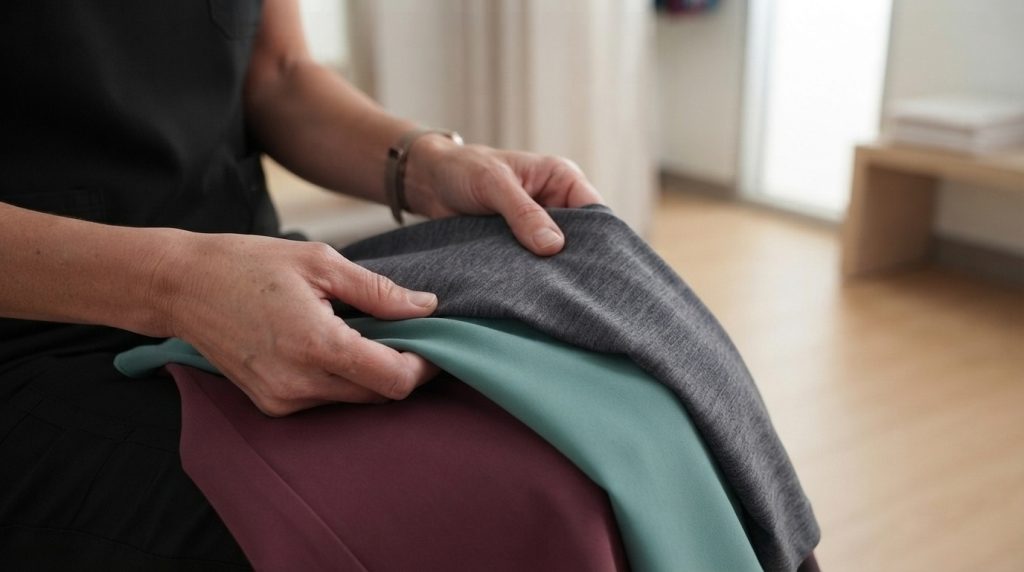
A scrub fabric can influence:
- Surface feel
- Stretch
- Weight
- Drape
- Drying behavior
- Wrinkle appearance
- Garment structure
The most useful comparison is not simply polyester versus rayon or nylon versus spandex.
It is how the complete textile and garment perform together.
Compare stretch according to normal movement
Stretch may help clothing move during reaching, bending, sitting, and walking.
However, stretch cannot correct:
- The wrong inseam
- An oversized waistband
- An unsuitable rise
- Poor shoulder proportions
A stretch fabric is a performance characteristic, not a substitute for correct fit.
Read official collection information
Official brand sources can help clarify fabric and performance differences.
IRG describes its EPIC collection around workday comfort, tailored fits, functional pockets, and modern styling. Its Edge collection is positioned around a lightweight, cotton-like fabric feel with durability and modern fits.
These collection-level differences demonstrate why shoppers should not treat “IRG” as one single fabric experience.
Consider softness and structure separately
Some professionals prefer soft, fluid fabric.
Others prefer a more structured garment that maintains a defined silhouette.
Neither preference is automatically more professional.
Ask:
- Does the fabric drape closely?
- Does the top maintain its shape?
- Does the pant feel lightweight?
- Is the material comfortable when sitting?
- How does the fabric feel beneath a jacket?
Personal preference matters because the same fabric can receive very different reactions from different wearers.
What should you know about Cherokee Revolution scrubs?
A brand collection should be evaluated according to documented features and available styles rather than broad assumptions about the entire manufacturer.
The official Cherokee Workwear Revolution women’s collection describes a polyester, rayon, and spandex twill blend with two-way stretch. The collection also highlights a broad size range and maternity availability.
Healthcare professionals considering Cherokee Revolution scrubs can therefore ask whether the collection’s fabric, sizing, and available silhouettes align with their needs.
Who may prioritize a broad size range?
Size availability becomes particularly important for:
- Healthcare teams
- Medical offices
- Individual professionals whose preferred size is difficult to find
- Workers who need maternity options
- Employers trying to use one coordinated collection
A collection with multiple sizes is not automatically the best choice for everyone, but broader availability can simplify uniform planning.
Look beyond the fabric blend
Even when several garments use a related fabric, the wearing experience may change according to:
- Top cut
- Pant rise
- Waistband
- Pocket placement
- Mesh panels
- Leg shape
Cherokee’s official men’s Revolution information, for example, describes the collection’s polyester, rayon, and spandex twill and notes two-way stretch, while individual styles can include additional design details.
The individual garment still matters.
What should you know about HH Works by Healing Hands?
The official Healing Hands website positions HH Works as a retailer-exclusive collection and describes it around function, modern design, practical details, dependable sizing, inventory availability, and suitability for individuals or teams.
Someone exploring Healing Hands scrubs should therefore consider whether HH Works aligns with the need for everyday professional apparel, team coordination, and practical style availability.
Why collection availability matters
A scrub can fit perfectly, but healthcare workwear is often a repeat purchase.
Professionals may later need:
- Another top
- Replacement pants
- A second approved color
- A different pant length
- Additional work sets
Medical offices may also need the same uniform for new employees.
This makes product availability a legitimate buying factor.
Team needs are different from individual needs
An individual can choose a scrub based almost entirely on personal fit preference.
A healthcare organization has additional questions:
- Can different body proportions be accommodated?
- Are men’s and women’s options available?
- Is sizing predictable enough for a group program?
- Can the collection support future staff additions?
- Are professional styles available for different roles?
The official HH Works collection specifically presents itself as an option for both individual professionals and department-level needs.
Does brand matter more than scrub collection?
Usually, the collection deserves more attention during the final decision.
The brand helps define the broader product family.
The collection often defines:
- Fabric
- Fit philosophy
- Styling
- Available garments
- Performance descriptions
The individual product then determines:
- Exact neckline
- Pocket count
- Pant silhouette
- Rise
- Inseam availability
- Garment dimensions
A useful shopping hierarchy is:
Brand → Collection → Garment → Size and Length
For example, someone may start by exploring a manufacturer, narrow the search to a performance-oriented collection, select a jogger pant, and then choose petite, regular, or tall length.
Skipping directly from brand name to size can overlook important collection differences.
How should nurses compare scrub brands?
Nurses should begin with the realities of their specific role and unit rather than assuming all nursing work has identical uniform needs.
Consider:
- Normal amount of walking
- Pocket use
- Workplace color rules
- Layering
- Pant length
- Waistband preference
- Top coverage
- Shift laundry routine
Movement
Test shoulder, knee, and hip movement.
Walk, sit, and bend in the garment.
Storage
Identify which approved items are actually carried.
Do not choose a scrub simply because the description advertises many pockets.
Shift rotation
Consider how many sets are needed between laundry cycles.
Care requirements and drying preferences may become more important when scrubs are washed frequently.
How should doctors and medical providers compare scrub brands?
Physicians and other medical providers may work across hospitals, specialty offices, outpatient clinics, and other healthcare environments.
The work setting should guide the uniform decision.
Consider lab coat layering
When scrubs are worn beneath a lab coat, evaluate:
- Shoulder bulk
- Sleeve comfort
- Chest pocket placement
- Fabric weight
- Top length
Try the garments together whenever possible.
Consider professional silhouette
Some healthcare settings may place greater emphasis on a structured, coordinated appearance.
This does not mean the garment needs to be restrictive.
Look for a fit that supports movement while maintaining the desired workplace appearance.
How should medical offices compare scrub brands for a team?
Team uniform decisions require more than identifying the office manager’s favorite scrub.
A group program should evaluate:
- Size range
- Length options
- Men’s and women’s styles
- Maternity availability
- Color consistency
- Jacket availability
- Replacement practicality
- Branding or embroidery needs
Standardize strategically
A medical office may standardize:
- One brand and collection
- One collection color
- Several approved styles
- Specific embroidery
Employees can then choose from approved fits.
This approach can provide consistency without forcing every employee into the same pant silhouette.
Test the collection before a full rollout
Select representative garment options and assess:
- Fit
- Fabric
- Sitting comfort
- Movement
- Pocket use
- Layering
Collect structured feedback.
Do not place a large group order based only on an online product image.
Is a more expensive scrub brand always better?
No.
Price alone does not determine whether a scrub is suitable for a particular worker.
A higher-priced garment may include features a worker values.
It may also include features that are irrelevant to another role.
The better comparison is cost relative to actual need.
Ask:
- Does the fit work?
- Is the preferred length available?
- Are the pockets useful?
- Does the fabric suit the workplace?
- Can the garment be maintained according to the normal routine?
- Will additional approved pieces be available?
A scrub that repeatedly requires adjustment is not automatically a better purchase because it carries a higher price.
Likewise, selecting purely by the lowest initial price can overlook fit and workwear requirements.
How important are scrub care instructions?
Care instructions should be reviewed before buying several sets from an unfamiliar collection.
The Federal Trade Commission explains that covered garments must carry care instructions under its Care Labeling Rule. The label gives consumers a regular care method for the product.
Healthcare professionals can review the FTC guidance on clothing care labels for broader information about apparel care instructions.
For actual scrub care, follow the label attached to the garment.
Why care matters when comparing brands
Consider the normal workwear routine.
Ask:
- How frequently are scrubs washed?
- Is quick turnaround important?
- Does the garment require special treatment?
- How does the fabric fit into the normal laundry routine?
A fabric feature is only useful when it works with the wearer’s actual routine.
Should you mix scrub brands?
It depends on workplace requirements and personal preference.
An individual professional may use different brands for different needs.
For example:
- One collection for joggers
- Another for straight-leg pants
- A different scrub jacket
- A separate lab coat brand
However, color coordination can become more difficult.
“Navy” or another common color name does not guarantee an identical visual match across different fabrics and manufacturers.
When matching matters
For a coordinated set, selecting tops and pants from the same collection can make color and fabric coordination simpler.
For healthcare teams, approved collection rules may also reduce variation.
When mixing may be practical
Mixing brands may make sense when:
- Workplace rules allow it
- Exact color matching is not required
- Different body proportions require different cuts
- A particular category is unavailable in the preferred collection
Fit should not be sacrificed simply to maintain brand loyalty.
What are the most important questions to ask before choosing a scrub brand?
Use these questions:
Fit
- Does the top fit correctly at the shoulders?
- Is the preferred pant rise available?
- Does the waistband remain secure?
- Is there enough hip and thigh mobility?
Length
- Are petite, short, regular, or tall pants available?
- Does the inseam suit the pant style?
Fabric
- Is the preferred fabric weight available?
- Does the material offer the desired stretch?
- Is the fabric soft or structured enough for personal preference?
Function
- Are the pockets useful?
- Does the garment work with normal layering?
- Can the wearer move without repeated adjustment?
Workplace
- Is the color approved?
- Are joggers or alternative pant styles allowed?
- Are embroidery or branding requirements involved?
Availability
- Can additional sets be purchased later?
- Are related tops, pants, or jackets available?
- Can the collection support group needs if required?
Common mistakes when choosing a scrub brand
Choosing based only on social popularity
A widely discussed scrub may still have the wrong fit for an individual wearer.
Treating every collection from one brand as identical
Fabric and garment design can change between collections.
Ignoring inseam options
The right fabric cannot correct excessive or insufficient pant length.
Buying by softness alone
Soft fabric may feel pleasant, but rise, waistband, pockets, and proportions still matter.
Assuming more stretch means a better fit
Stretch supports movement. It does not fix an incorrect size.
Counting pockets without checking their location
Pocket placement determines practical usefulness.
Ignoring future availability
Healthcare professionals often need additional sets or replacements.
Buying several sets before testing one
An unfamiliar collection should be assessed for fit and movement before a large personal or team purchase.
A simple way to compare three scrub brands or collections
Create a practical comparison based on your workday.
| Factor | Collection A | Collection B | Collection C |
| Shoulder fit | Check | Check | Check |
| Preferred pant rise | Check | Check | Check |
| Petite/tall availability | Check | Check | Check |
| Fabric weight | Check | Check | Check |
| Stretch preference | Check | Check | Check |
| Pocket placement | Check | Check | Check |
| Layering comfort | Check | Check | Check |
| Approved work colors | Check | Check | Check |
| Care routine | Check | Check | Check |
| Future availability | Check | Check | Check |
Do not score a collection based on marketing phrases.
Try to answer each factor according to actual fit and work requirements.
Professionals who prefer to compare fabrics, lengths, and scrub silhouettes in person can also visit a medical scrub store in Wilmington while evaluating different workwear options.
How to choose a scrub brand step by step
- Check workplace requirements. Confirm approved colors, garment styles, and branding rules.
- Describe the normal workday. Identify sitting, walking, reaching, and layering needs.
- Measure fit requirements. Note size, inseam, and preferred rise.
- Choose the desired pant silhouette. Compare jogger, tapered, straight, or other styles.
- Identify fabric priorities. Consider stretch, weight, softness, and structure.
- List storage needs. Match pocket placement to actual work items.
- Shortlist collections, not only brands. Review official collection information.
- Check size and length availability. Verify the specific garment.
- Test movement and layering. Wear the scrubs as they will be used at work.
- Review care instructions. Make sure the garment fits the normal laundry routine.
- Consider replacement needs. Think beyond the first set.
- Buy additional sets after confirming fit. Avoid building a full rotation around an untested garment.
Final Thoughts
Choosing a scrub brand should be a workday decision rather than a popularity contest.
Start with fit. Determine the correct pant length, rise, and preferred silhouette. Then evaluate fabric weight, stretch, drape, pockets, and layering. Finally, consider whether the collection offers the sizes, colors, and related garments needed for future purchases.
Brands such as IRG, Cherokee, and Healing Hands offer distinct collections with their own documented design and fabric priorities. Official collection information confirms that even products within the broader scrub market can differ significantly in fit approach, fabric characteristics, and intended use.
The best scrub brand is ultimately the one whose specific collection and garment fit the wearer’s body proportions, workplace requirements, and everyday job needs.
Frequently Asked Questions
How do I choose the best scrub brand?
Start with workplace requirements and your normal job duties. Then compare scrub collections by fit, pant rise, inseam options, fabric, stretch, pockets, and care needs. The best brand is the one with a collection that matches your body proportions and workday rather than the most popular name.
Does the scrub brand matter or just the fabric?
Both the brand and fabric can provide useful information, but the specific collection and garment deserve closer attention. Collections from the same brand may use different textiles, fits, waistbands, and styling. Fiber content alone also does not explain how the complete garment will fit.
Should nurses choose stretchy scrubs?
Stretch can support garment movement during walking, sitting, reaching, and bending. However, nurses should also evaluate waistband fit, inseam, rise, shoulder room, and pockets. A stretchy fabric cannot compensate for an unsuitable garment size or proportion.
Is it better to buy scrub tops and pants from the same brand?
Buying from the same collection can make color and fabric coordination simpler. However, healthcare workers may mix brands when workplace rules allow and different fits better suit their proportions. Exact color matching should be checked because similarly named colors can vary.
What should medical offices consider when choosing a scrub brand?
Medical offices should consider size range, men’s and women’s options, pant lengths, maternity availability, approved colors, garment variety, replacement availability, and branding needs. A team uniform program should support different body proportions while maintaining the organization’s chosen appearance standard.