
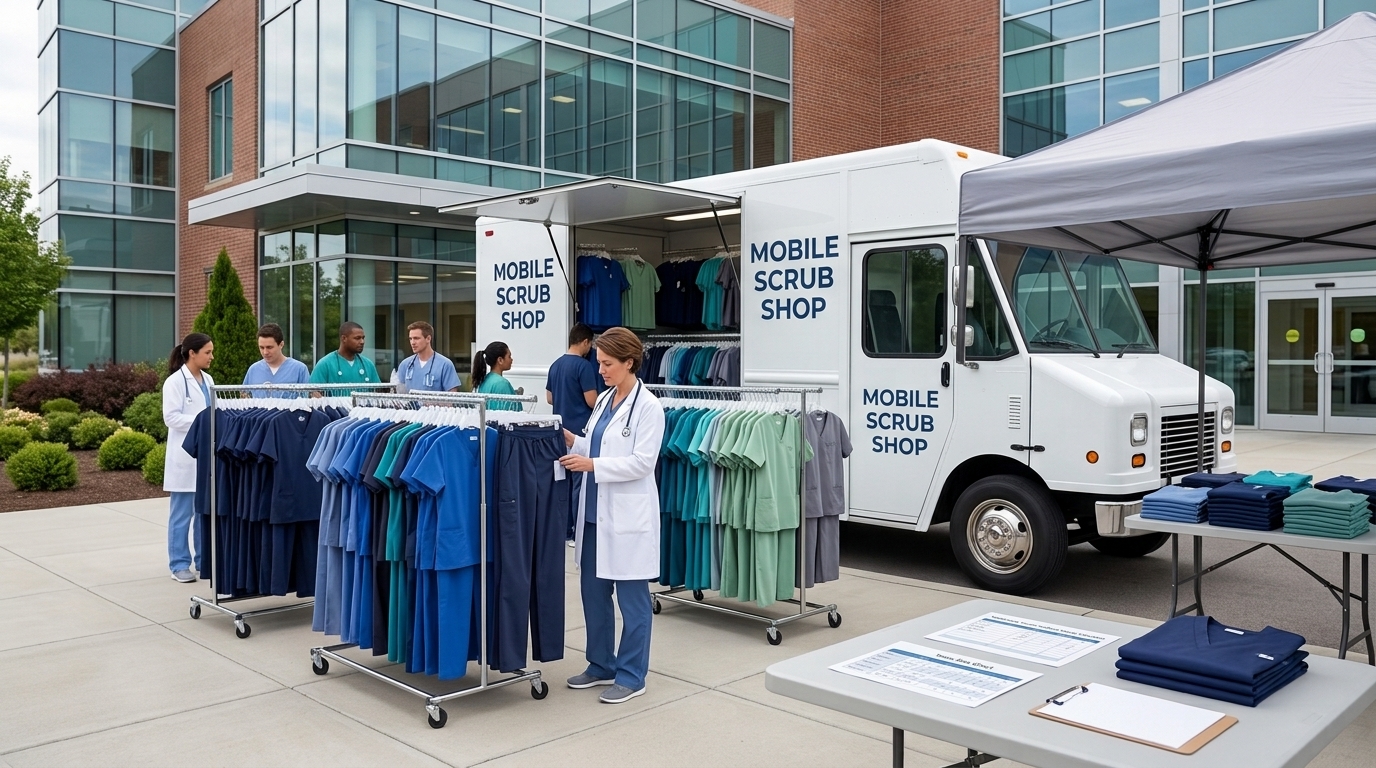
Buying uniforms for a healthcare team can be time-consuming when staff have different schedules, sizes, roles, and fit preferences. A mobile scrub store or onsite fitting service can simplify that process by bringing scrub options directly to the workplace, helping employees compare styles, confirm sizing, and choose uniforms without making separate store visits.
This approach can be especially useful for clinics, dental offices, veterinary practices, home care teams, long-term care facilities, and medical groups. Instead of asking every employee to shop individually, a team can coordinate fittings, color standards, embroidery details, and uniform ordering in one structured process.
Key Takeaways
- Mobile scrub stores bring uniform options directly to healthcare workplaces, which can reduce scheduling problems for busy teams.
- Onsite fittings help staff compare sizes, styles, fabrics, and lengths before ordering, reducing the risk of poor fit.
- Group uniform programs should account for men’s, women’s, petite, regular, tall, jogger, and layering needs.
- Office managers should plan colors, embroidery, staff sizing, and reorder rules before placing a full team order.
- Mobile uniform services work best when the team prepares dress code details, size needs, and role-specific requirements in advance.
Healthcare teams exploring a mobile scrub store should think beyond convenience. The real value is better organization, better sizing, fewer separate shopping trips, and a more consistent uniform program.
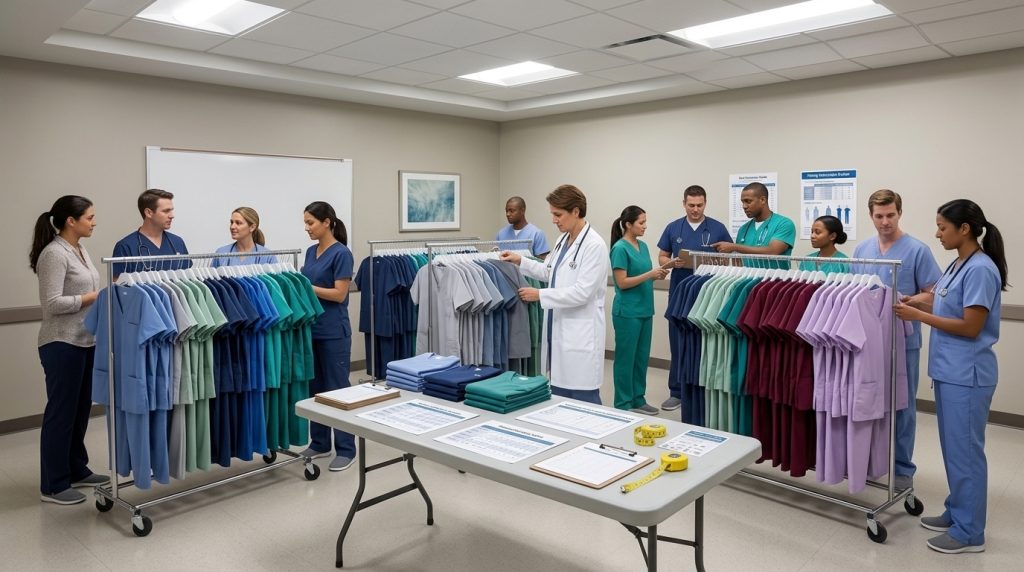
Why Mobile Scrub Stores Are Useful for Healthcare Teams
Healthcare teams are busy. Staff may work different shifts, cover multiple locations, or have limited time outside work to shop for uniforms. When every employee shops separately, the result can be inconsistent colors, mismatched fits, wrong sizes, and delays for new hires.
A mobile scrub store helps solve this by bringing scrub options closer to the team. Staff can review garments during a scheduled fitting window, compare sizes, and ask questions before selecting uniforms. This is especially useful when a group order involves embroidery, department colors, or specific role-based uniform rules.
The U.S. Bureau of Labor Statistics shows that healthcare workers are employed across hospitals, physicians’ offices, outpatient centers, nursing facilities, home healthcare, and many other care settings. Because the workforce is so varied, uniform planning often needs to account for different roles, work environments, and physical demands. The BLS overview of healthcare occupations is a helpful reference for understanding the range of professional settings involved.
A mobile uniform service may help teams:
- Reduce individual shopping trips
- Improve size accuracy
- Compare fabric and fit in person
- Coordinate colors across departments
- Plan embroidery and logo placement
- Support new-hire uniform ordering
- Keep records for future reorders
- Make uniform buying easier for office managers
The goal is not only to sell scrubs. The goal is to create a cleaner, more efficient uniform process.
What Is an Onsite Scrub Fitting?
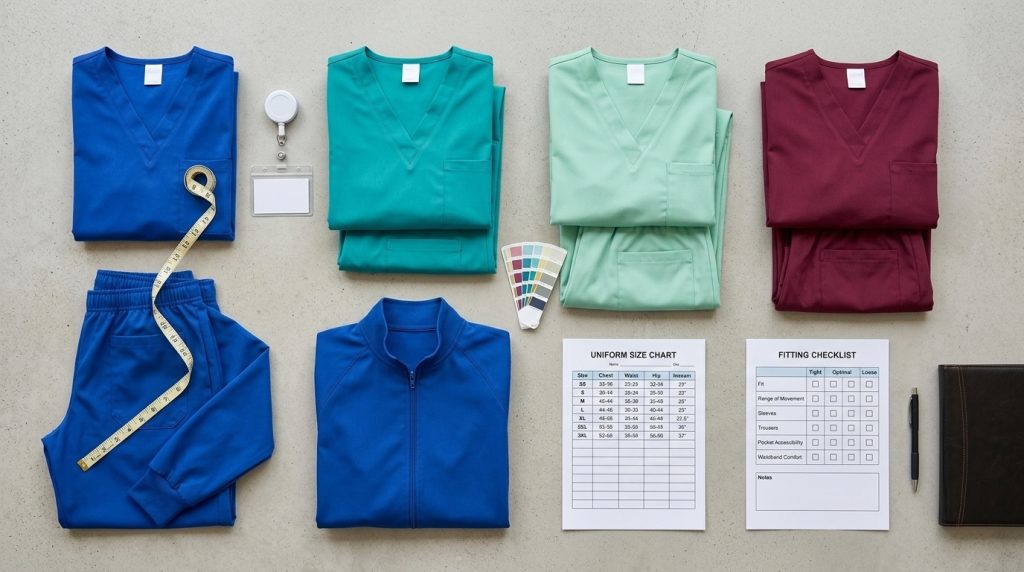
An onsite scrub fitting is a scheduled uniform fitting session held at a healthcare office, clinic, facility, or workplace. Staff can review sample garments, try sizes, compare styles, and provide order details without leaving the worksite.
A team considering onsite scrub fittings should use the session to answer practical questions:
- Which scrub colors are approved?
- Which styles fit the team best?
- Which sizes are needed?
- Are men’s and women’s fits required?
- Are petite or tall lengths needed?
- Will the team need jackets or lab coats?
- Is embroidery required?
- How will new employees reorder later?
Onsite fittings are especially helpful when the team includes many body types or when embroidery makes exchanges more complicated. It is much better to confirm sizing before customization than to correct mistakes after garments are embroidered.
When a Mobile Scrub Store Makes the Most Sense
Mobile scrub services are not only for large hospitals. They can also be useful for small and mid-sized healthcare groups that want a more organized uniform process.
New Clinic Openings
A new clinic may need uniforms for the entire team before opening. A mobile fitting can help staff choose coordinated scrubs, confirm sizing, and prepare embroidery details before the launch date.
Rebranding or Uniform Updates
When a practice changes its colors, logo, or dress code, staff may need new uniforms at the same time. A mobile fitting can make the transition smoother and reduce confusion.
Growing Teams
A growing healthcare office needs a repeatable process for new hires. If uniform details are documented during the first order, future staff can be added more easily.
Multi-Location Teams
When employees work across several locations, uniform consistency can become harder to manage. A mobile uniform process can help standardize colors, styles, and ordering rules across the group.
Busy Staff Schedules
Healthcare employees may not have time to visit a scrub store individually. Bringing the fitting to the workplace helps reduce friction and improves participation.
For local planning, a verified Dayton healthcare uniform service listing can help managers confirm store details and local service information before coordinating a team uniform plan.
How Office Managers Should Prepare for an Onsite Fitting
Preparation makes the fitting more productive. The more information collected before the session, the fewer problems the team will face during ordering.
Confirm Dress Code Rules First
Before scheduling a fitting, managers should confirm the workplace uniform policy. This avoids selecting styles or colors that do not meet internal requirements.
Important details include:
- Approved scrub colors
- Approved top styles
- Approved pant styles
- Department color coding
- Jacket or underscrub rules
- Lab coat requirements
- Footwear guidelines
- Embroidery or logo standards
- Name and credential formatting
- Laundering expectations
If the workplace has no formal policy, the onsite fitting is a good opportunity to create one.
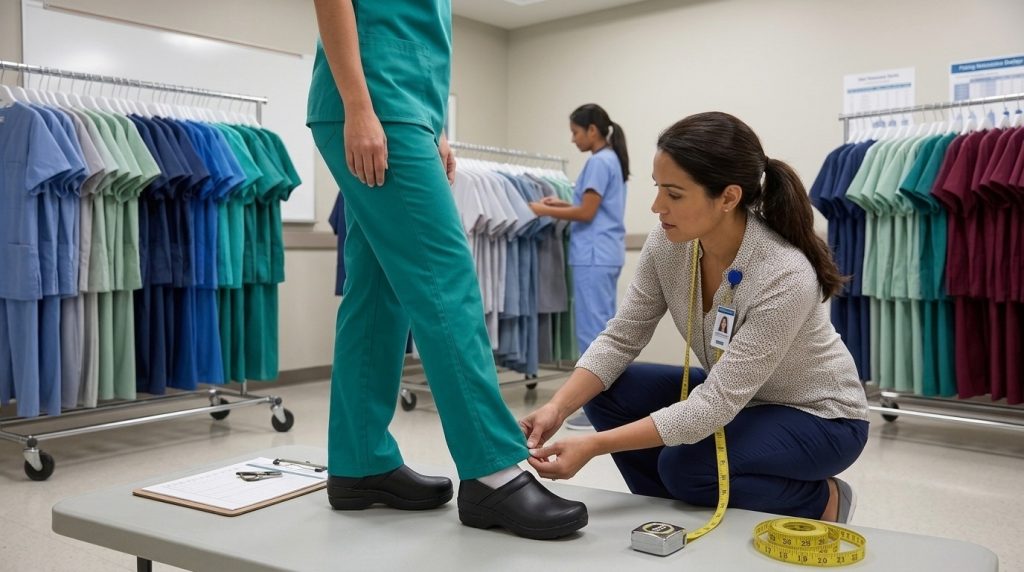
Build a Staff Size List
The office manager should prepare a preliminary size list before the fitting. This does not replace try-ons, but it gives the uniform provider a better idea of what samples and sizes may be needed.
The list may include:
- Employee name
- Role or department
- Top size
- Pant size
- Men’s or women’s fit preference
- Petite, regular, tall, or short length needs
- Jacket size
- Lab coat size
- Embroidery name and credentials
This keeps the session organized and helps avoid missing key details.
Decide Who Has Final Approval
For group orders, someone should be responsible for final decisions. Staff can provide fit preferences, but a manager may need to approve colors, embroidery, budget, and final order quantities.
What Staff Should Check During an Onsite Fitting
A fitting session should not be treated like a quick size guess. Staff should test scrubs the way they will actually be worn during work.
Scrub Top Fit
A scrub top should allow movement through the shoulders, chest, upper back, and arms. It should not pull when reaching or feel too loose when bending.
Staff should check:
- Shoulder mobility
- Sleeve comfort
- Neckline coverage
- Torso length
- Pocket placement
- Side vents
- Fit under a jacket or lab coat
Scrub Pant Fit
Pant fit is often the hardest part of group uniform ordering. Waistband style, rise, inseam, thigh room, and leg opening can vary by brand and cut.
Staff should test:
- Sitting comfort
- Waistband security
- Thigh and knee movement
- Inseam length with work shoes
- Pocket access
- Jogger cuff fit, if applicable
- Rise height when bending or sitting
A pant that looks fine while standing may feel uncomfortable during a full clinical shift.
Fabric Feel
Fabric should feel comfortable against the skin and appropriate for the work environment. Some staff may prefer lightweight stretch fabric, while others may prefer a more structured feel.
Staff should compare:
- Softness
- Stretch
- Breathability
- Thickness
- Recovery after movement
- Wrinkle resistance
- Overall comfort
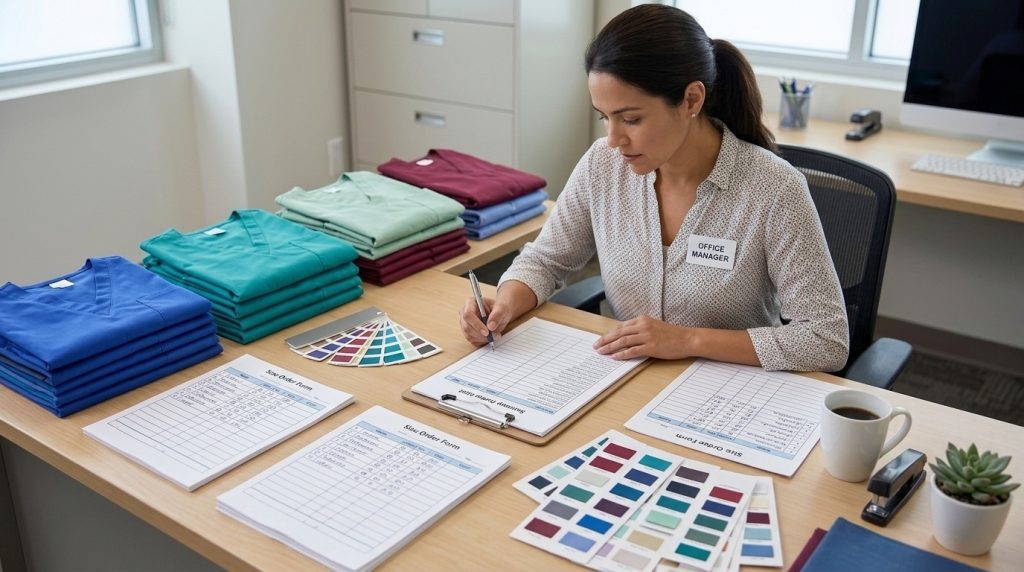
Planning Uniforms for Different Healthcare Roles
A team uniform program should account for role differences. One uniform style may work for everyone in a small office, but larger teams often need more flexibility.
Nurses and Clinical Assistants
Nurses and clinical assistants often need flexible fabric, practical pockets, and comfortable waistbands. They may prefer scrub pants that allow bending, walking, and frequent movement.
Dental Teams
Dental teams may prioritize coordinated appearance, easy-care fabric, and comfortable movement. Embroidery can help create a polished and consistent look.
Veterinary Teams
Veterinary staff may need durable scrubs that support bending, lifting, cleaning, and active movement. Pocket placement and fabric strength can be important.
Home Care and Hospice Teams
Home care and hospice workers may need scrubs that look professional outside a traditional clinic. Comfort, mobility, and easy laundering are especially important for workers who travel between patients.
Front Office and Administrative Clinical Staff
Front office staff may need professional apparel that coordinates with the clinical team without requiring the same pocket-heavy or performance-focused features.
Fabric, Laundering, and Hygiene Considerations
Uniforms should be selected with laundering in mind. Healthcare apparel may be washed frequently, and some workplaces may have specific policies for contaminated clothing or textile handling.
The CDC provides guidance on healthcare laundry and bedding, including considerations for textiles in healthcare settings. Teams should follow employer rules, garment care labels, and any applicable infection-control procedures.
When choosing team scrubs, compare:
- Wash instructions
- Drying instructions
- Bleach restrictions
- Wrinkle resistance
- Color retention
- Shrinkage risk
- Fabric durability
- Stain management expectations
A uniform that looks good during fitting but is difficult to maintain may create long-term problems.
How Mobile Scrub Services Support Group Orders
A mobile scrub store is especially useful when connected to a larger group ordering process. It helps bridge the gap between individual fit and team consistency.
A strong healthcare uniform service should help with:
- Staff fitting sessions
- Size collection
- Brand and style selection
- Color coordination
- Embroidery planning
- Logo setup
- Group order organization
- Reorder support
- New-hire uniform planning
This matters because healthcare teams change over time. New staff join, employees change sizes, garments wear out, and departments may update their uniform standards. A clear process makes reordering easier.
Embroidery and Branding During Mobile Fittings
Embroidery should be planned carefully because customized garments are harder to exchange. The onsite fitting should confirm garment style and size before names, credentials, or logos are added.
Logo Placement
Common embroidery areas include the left chest, sleeve, or jacket front. Placement should work across different sizes and body shapes. A logo that looks balanced on one size may need adjustment for another.
Name and Credential Format
Teams should decide whether staff names, credentials, titles, or departments will be included. Formatting should be consistent.
For example, the team should decide:
- First name only or full name
- Credentials included or excluded
- Job title included or excluded
- Logo above name or separate
- Thread color
- Font style
- Capitalization style
Proofing
Before approval, review spelling, logo size, placement, thread color, and garment color. Proofing is one of the most important steps in preventing expensive mistakes.
Budget Planning for Mobile Scrub Orders
Uniform budgets should consider more than the first order. Managers should think about replacement needs, new hires, embroidery costs, jackets, lab coats, and future reorders.
Cost Factors
Group scrub order costs may include:
- Scrub tops
- Scrub pants
- Jackets
- Lab coats
- Embroidery
- Logo setup
- Extra uniforms
- Replacement garments
- New-hire uniforms
Value Factors
The lowest-cost option may not always be best. If scrubs fade, shrink, lose shape, or feel uncomfortable, staff may need replacements sooner.
Better value often comes from balancing:
- Fit accuracy
- Durability
- Comfort
- Reorder availability
- Staff satisfaction
- Professional appearance
- Laundering performance
For full-time staff, higher-quality uniforms may provide better cost-per-wear over time.
Scrubs and Workplace Safety
Scrubs are professional uniforms, but they are not a replacement for personal protective equipment. OSHA explains that personal protective equipment is used to reduce exposure to workplace hazards that may cause injuries or illnesses.
Healthcare teams should make sure uniform decisions do not conflict with PPE requirements, infection-control rules, or workplace safety policies. Depending on the setting, staff may still need gloves, gowns, masks, eye protection, respirators, or other required protective items.
Creating a Reorder System After the First Fitting
The first mobile fitting should create a foundation for future orders. Without a saved system, the team may face mismatched colors, discontinued styles, or inconsistent embroidery later.
A practical reorder record should include:
- Approved scrub brand or collection
- Approved colors
- Approved top styles
- Approved pant styles
- Approved jacket styles
- Approved lab coats
- Embroidery placement
- Logo file details
- Thread colors
- Employee size history
- New-hire ordering process
- Backup style options
This record helps the team stay consistent as staffing changes.
Common Mistakes to Avoid
Mobile fittings can make uniform buying easier, but teams still need a clear process.
Avoid these mistakes:
- Scheduling a fitting before confirming dress code rules
- Choosing colors without checking reorder availability
- Ignoring petite, tall, short, or jogger needs
- Assuming one fit works for everyone
- Forgetting jackets or lab coats
- Skipping embroidery proofing
- Failing to document final style choices
- Ordering too few backup pieces
- Not planning for new hires
- Choosing price over long-term durability
A mobile fitting works best when it is organized, documented, and connected to a long-term uniform plan.
Final Thoughts
Mobile scrub stores and onsite fittings can make healthcare uniform buying more efficient for busy teams. Instead of sending every employee to shop individually, the fitting process brings styles, sizes, fabrics, and ordering support directly to the workplace.
For clinics, dental offices, veterinary practices, home care teams, and healthcare groups, the main benefits are convenience, better sizing, improved consistency, and easier reorder planning. A thoughtful mobile fitting should help the team choose uniforms that look professional, feel comfortable, support daily work, and remain manageable as the organization grows.
FAQs
What is a mobile scrub store?
A mobile scrub store brings medical scrub options directly to a workplace, clinic, or healthcare facility. Staff can browse styles, compare sizes, review fabrics, and select uniforms without making separate store visits. It is especially useful for group orders and busy healthcare teams.
What happens during an onsite scrub fitting?
During an onsite scrub fitting, staff usually compare sample garments, try different sizes, review fabric options, confirm pant lengths, and provide order details. The team may also discuss colors, embroidery, logos, jackets, lab coats, and future reorder needs.
Are onsite scrub fittings useful for small clinics?
Yes. Small clinics can benefit from onsite fittings when they want consistent uniforms, accurate sizing, embroidery, or a smoother ordering process. Even a smaller team may have different size needs, fit preferences, and role-based uniform requirements.
How should a healthcare team prepare for a mobile uniform fitting?
A team should confirm dress code rules, approved colors, staff size needs, embroidery details, budget, and final approval responsibilities before the fitting. It also helps to collect employee names, roles, top sizes, pant sizes, and inseam preferences in advance.
Can mobile scrub services help with embroidery?
Many group-focused uniform services can help coordinate embroidery, including logo placement, name formatting, credentials, thread colors, and proof approval. Since embroidered garments are harder to exchange, sizing should be confirmed carefully before customization.